Posts Tagged ‘fish’

Basket Trouble in Mali

by Cecilia Hue, Assistant Producer, Deserts/Grasslands Team 

This is my last filming trip for ‘Human Planet’ and I am going back to Mali, which has become my second home since I joined the Bristol team a couple of years ago.  The journey starts with the most extraordinary beginning, the stuff of Hollywood movies.  A volcano which no-one has ever heard of, with an unpronounceable name, erupts in Iceland and spews so much volcanic ash into the air that European air space has ground to a halt – the morning we were supposed to fly to Mali!  What would normally take five and half hours by plane ends up taking over 100 hours!  Our production co-ordinator Isabelle Corr cool as a cucumber, as ever, (see photo below!) cunningly devises a roundabout route via ferry to northern Spain, a drive to Madrid and two flights that finally land us in Bamako, Mali. 

Isabelle in the office

We are determined to make it in time for an event which only takes place once a year: a fishing festival in the desert, possibly the most dramatic sequence in the Deserts programme.  Once in Mali we still have a two-day journey by road before we get to location.  It is incredibly hot, 45 degrees (which for those who have never experienced it feels like having your head stuck in an oven ), we get  punctures, and an incredible sandstorm which leaves the whole team caked in a layer of orange dust.  We look as if we’ve all been ‘Tangoed’!   

Robin, Andrew & Cecilia after the storm

We finally arrive in the Dogon village of Bamba, built among boulders at the foot of an incredible 500 m high escarpment which cuts through the monotony of the Sahel for over a hundred miles.  Everything here is parched as the dry season reaches its peak, leaving only one sacred pond full of catfish (which have retreated to this last haven as all the rivers dried up).  
It’s 7am on Saturday 24th April.  The day of the fishing festival has finally arrived.  The Dogon are very superstitious.  Women are not allowed anywhere near the sacred pond.  As I am the only woman in the team I am gently ushered away from the scene by my fixer.  I am told that I might lose my fertility if I stay.  Frankly, I am not prepared to take any risks so I join the other women in the village.  They are all busily getting ready for the celebration – braiding their hair and pounding millet for the big feast.  
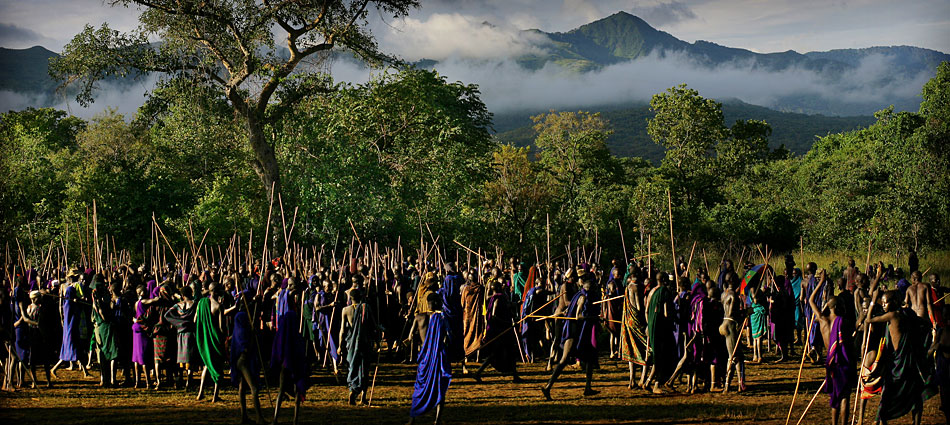
In the meantime, the crew is preparing to film the fishing frenzy which will last no more than 15 minutes and is unrepeatable for religious reasons. There’s no room for error.  4000 bare-chested men -including our character Amadou – have turned up to the pond the size of an Olympic swimming pool, armed with their cone-shaped fishing baskets, ready to charge in.  They hope to catch a fish or two.  If they do, they believe it will bring good rains and a subsequent abundant harvest for their family and their village.   

Antogo


Antogo

Our character is fortunate to have made it to the festival.  The day before, he almost got kidnapped from the film set by a mob of angry men from the neighbouring village.  We had caused deep offence by bringing his fishing basket onto their territory.  We soon discovered that the basket was a painful reminder of the village’s defeat against Bamba in the battle for control over the pond.  We had made a terrible basket faux pas!  We apologized profusely to Amadou’s arch enemies and were asked to give a small payment to repair the harm. 

To see the full story of the fishing festival, look out for the “Human Planet”  Deserts  programme!


Where are the Fish?

by Rachael Kinley, Researcher, Oceans and Jungles team

Of the three months that I’ve been on location for Human Planet Oceans shoots, over half of this time has been spent waiting for fish to appear.  Off the shores of three continents, from sunrise to sunset, we’ve searched the open seas desperately hoping for some ‘sign’ that they are on their way.

Fisherman Taba waiting for mullet in Mauritania

First it was waiting for migrating mullet in Mauritania. The idea was to film with the Imraguen people who inhabit the Bank D’Arguin National Park and fish the huge numbers of mullet that pass through their waters each year.  Every day for two weeks we optimistically headed out to sea in the fishermen’s dhows, but the mullet never arrived.  Was it the moon, the wind or the water temperature?  We will probably never know but after much debate we reluctantly decided to call off the shoot.

Fishermen waiting for the fish migration in Brazil

Then we moved on to Laguna on the coast of southern Brazil to try again to film a similar story.  It was hard to decide when was the best time to go as the local fishermen seemed to have wildly conflicting ideas of when the mullet season actually occurred. In the end we embarked on our trip in mid May and although at first it looked as if we were going to be unlucky for a second time, after spending three weeks on location we finally managed to film fishermen hauling in impressive numbers of fish.

Here I am heading out to sea in the Philippines

OK, so we were successful, but it was touch and go for quite a while and I swore I would never go on another shoot that depended on fish turning up.  But what do you know, this October I was off again on another wild fish chase. This time it was off the coast of Palawan in the Philippines, sailing for fourteen hours a day for seven days with deep sea diving fishermen desperate to land a big catch.  Sitting out at sea on a boat in the tropics, overlooking palm tree fringed sandy beaches, is not the worst place in the world to be left in limbo, but after days on end of no filming opportunities and burning our budget, even paradise can lose its appeal.  But as so often seems to be the case on Human Planet shoots, on the very last day we finally managed to net something spectacular enough to make the cut.

A catch at last!

We had what we needed, but I was dismayed to hear that even this catch was half the size of those that the fishermen said they used to get. The problem was not that the people had been lying to us about when and where the fish come in, nor that they had lost their traditional skills, but that there are no longer plenty of fish in the sea.  Although newspapers and documentaries such as End of the Line tell us that global fish stocks are declining, as we still see plenty of fish on our supermarket shelves, it is all too easy to ignore the warnings.

Celebrating a catch with new friends

I myself was aware of the problem, but it was really brought home to me by witnessing first hand how barren the seas of the world have become.  At first the persistent lack of fish on our shoots seemed little more than the annoying bad luck that can plague any film shoot, but talking to people whose lives and livelihoods depend on maritime resources, I have become increasingly aware that diminishing fish stocks are becoming a huge problem affecting millions, if not billions, of people around the world.  Having seen just how hard the lives of some of these people are already, I hate to think how they will survive if the fish disappear altogether.

Dale Templar – Series Producer – Human Planet

Heartache for Haiti

About six months ago, I sent assistant producer Willow off to do a recce in Haiti.  We were looking for a place to show the huge destructive force of hurricanes and Haiti is regularly caught in the path of the worst storms that sweep through the Caribbean.  Ironically, we never filmed in Haiti; in the 2009 season the hurricanes chose other paths.  It was a bitter-sweet failure for the series.  Willow and I were both aware we’d wasted time and money but also felt secretly pleased that the people of Haiti had escaped yet more devastation and destruction for another year.  We could never have imagined  the cruel twist of fate that would hit them just months later.   Of all the places on Earth for a earthquake of this magnitude to hit.   On her trip , Willow was given an insight into the desperation, poverty and hopelessness faced by the  majority of the Haitian population.   Hours after the earthquake, she and I talked on the phone, both unable to take in the enormity of the disaster.   She had been there, I had made films after the Kobe Earthquake in Japan and in Banda Ache following the Boxing Day Tsunami.   The hearts of the Human Planet team go out to the people of Haiti.   Maybe, just maybe, something good will come from this.


This website is made by BBC Worldwide

More from BBC Worldwide