Posts Tagged ‘Papua’

Little Human Planet

by Elen Rhys, Producer, Little Human Planet

When delightful Dale Templar told me that Human Planet had been commissioned, my brain immediately started working overtime.  Waw, what a great opportunity for a children’s spin off on CBeebies.   Surely, if they would be filming humans in far flung and remote locations around the world, they were bound to be meeting children too.  What a unique chance to work alongside this huge landmark commission to create something special for the BBC’s  youngest viewers.  And basically, that is how the CBeebies commission, Little Human Planet came to be.

Living in a treehouse

Little Human Planet is a little sister series to Human Planet.   It consists of 16 x 5 mins programmes that will be broadcast during the same period as the main series – but of course, at a time when 3-6 year olds are at their most attentive.

It’s a simple idea with a simple format.  Each programme follows a typical activity in the life of a child from around the world – a glimpse to a CBeebies viewer of how their counterparts live, wherever they may be.  On reflection, an unspoken celebration of what makes children different and what makes them the same in a colourful and often surprising voyage of discovery.

Children in Mali facing long trips to the well

Unfortunately, I didn’t get to pack my passport to film the sequences.  This was done by the brilliant Human Planet location teams.  Yes, we liaised closely together regarding style and vision, understanding that certain things like nudity or blood and gore couldn’t be used.  Naturally, this proved difficult in certain locations where few clothes, if any are worn and hunting for food is the norm.  I was never sure what I was going to get, only crossing my fingers they would meet some children and film some magic moments .  I’m  used to having a bit more control, so this was quite difficult for me but I soon realised I needn’t have worried. 

The doorway of a Mongolian ger

Each time a team came back with special Little Human Planet labelled footage it was like the anticipation and excitement of opening Christmas present. Who would, Dan Young, my editor and I  meet this time?  Could it be Dua, a six-year-old girl who lives in a tree house in a jungle in Papua or mischievous four-year-old, Carlos Eduardo, who lives on the flooded banks of the Rio Negro?  Or how about four-year-old Shoree helping her dad build a ger home in Mongolia, or three-year-old Edjongon, who walks long distances each day to collect water from a well in Mali?  Even though I have never met these fascinating characters, I feel as if I know them.  And though the children’s experiences, circumstances and environments differ hugely, I learnt that at heart children are all the same and their smiles are universal.

Happy faces in Mongolia

Yet, paradoxes come to light.  Without generalising, many of these children and families have very little, but yet, seem contented where community and sharing is a way of life.  It taught me a lot and got me thinking..As a mum to a six-year-old, have we in the Western world lost our perspective ?

Life in a stilt village in the Amazon basin

I am honoured, grateful and proud to be a tiny part of the Human Planet family and I hope there will be more opportunities like this in the future. If so, can I please come next time?

Dale Templar – Series Producer

Here’s hoping - Elen!

Little Human Planet is one of spin-offs programmes and extras that are part of the Human Planet . We have already had a post from our team at BBC, Radio Three working on Music Planet and in a few weeks we’ll have one from our BBC Learning team. They are using our footage to make programmes that will be  used as teaching aids in scools.


Tales of the unexpected

by Julia Wellard, Production Team Assistant, Bristol

The photo below was taken after a jungle shoot in the Central African Republic. The tents came back damp and smelly and needed a good airing, so Rachael Kinley (the researcher) and I had the bright idea of draping them over every surface we could find, including the office of our Series Producer, who was away at the time. We were planning to dry them out so they’d be in better shape to send off to be cleaned. What we weren’t planning on was a large eight-legged hitchhiker crawling out of one of the tents and multi-legging it down the stairs!

P1030259rachael tents

Since then, we’ve had other uninvited guests from overseas dropping into the office – the best count came after another jungle shoot – this time to western Papua to shoot treehouses. Final count was five cockroaches, two earwigs and another large spider! A few more to add to the many legends about animals coming back from NHU shoots and flying, slithering or creeping away into the bushes round the BBC Bristol car park.

As Production Team Assistant, this is the nearest I get to experiencing the wildlife the teams meet and film on location. But there are other ways I share in the challenges and excitement of location filming. Like Jasper in an earlier blog, I’ve had a few calls in the middle of the night, usually reassuring me that crews have arrived at the right place at the right time, but occasionally explaining they’ve had to beat a rapid retreat because of suspected guerrillas in the area – or mentioning that a bomb has just gone off near their hotel.

It can be fascinating building a complicated schedule involving flights, boat rides, horses, camels, helicopters and having to rearrange everything when one of the links in the chain breaks down. But the one I remember best is the day a long and very complex travel chain to Borneo had to be completely rejigged because of snow at Bristol Airport!


The Breast of Friends

By Rachael Kinley, Researcher, Jungles/Oceans team

Before filming begins, it’s important to spend time with the contributors without big cameras in their faces. It helps to strike up a friendly rapport and make the future weeks more productive and enjoyable for all. So, our first day in Papua with the Korowai is spent in their home, a tree house.

Making friends in the treehouse

Making friends in the treehouse

Korowai houses are communal and split into male and female sides, to avoid furtive touching in the evenings. So, as the rest of the crew, including the translator are men, I sit down with the women, while the crew all head outside to take in the view from the male balcony.

Friendship forming begins inside the house. In the UK, we’d receive cups of tea and cake, here it’s fire-charred lumps of sago palm, fresh from the flames. We start making net bags together, rolling lengths of rattan along our thighs, entwining the fibres to form a string which is then plaited together to create a bag that is strong enough to hold up to 70kg.

 DSC_0073 treehouse lores

Whilst we are winding, I try to spark up a conversation. But with Jim, our translator, out of sight this gets to be a bit tricky.  I only know one word in their language, and they know none in mine. I begin by pointing at items around us and learning the words for their shell necklaces, pet pig and net bags.  After we’ve exhausted everything on their person, the tables are turned and they start pointing and teaching me words for parts of my body – hair is  ‘habianto’ and breast, ‘am’.  They seem to be extremely intrigued by my breasts.

A couple of children reach over and prod them.  The older women giggle, encouraging the girls on.  The next thing I know, they start to unbutton my shirt.  The Korowai are both amazed at the lifting properties of my Gossard Superboost bra.  They begin to imitate its effect by cupping their own breasts in their hands with curious looks.  It feels slightly surreal to be sitting, metres up in a jungle tree house, being communally undressed by several women and children.  I help them to unfasten the clasp and the women stroke my breasts, smiling, giggling, repeating am am am.

DSC_0216 mother and baby lores_edited-1

It’s lovely, it’s touching, we laugh together and are definitely bonding. But amidst all this, my mind is thinking why couldn’t this be at the end of the four weeks in the jungle when I’d definitely be much thinner…. I guess that you can take your clothes off in the jungle, but it’s harder to get your head out of the UK.


Executive Decisions

 Brian 2 by hedge lowres


by Brian Leith, Executive Producer, Human Planet

I realise these blogs are supposed to be action-packed accounts of daring exploits posted by intrepid members of our filmmaking teams scattered to the farthest-flung corners of the world.  But this week I thought we’d bring you a surprise.

So, while we have one team (Mark and Renee) filming the capture of giant fish in the turbulent rapids of a river in Laos, another (Tuppence and Jane) filming tribesmen literally stealing a kill from hungry lions in Kenya, and another (Tom and Rachael) filming a house-move (!) atop a 40-metre tree in Papua – and yet another team (Nick and Bethan) filming a traditional Inuit whale hunt in Greenland… I’m bringing this front-line account to you from exotic Whiteladies Road in Bristol.

You see, not all of us in glamorous wildlife TV get to go on those exotic trips. Some of us have to man the telephones and sit in front of computers back at base, trying to keep track of it all.  Some of us are ‘production management’ staff, in charge of making plans and making sure those plans actually turn into film shoots; some of us are technical staff, trying to make sure that all those sounds and images gathered from around the world are transferred, logged, and stored in a suitable format so that we can actually make the series at the end of all this action; some of us are picture and sound editors, destined forever to sit in darkened rooms imagining what it must have been like to be on location when that mad thing happened.

And some of us never get to go anywhere at all because we’re… well, because we’re just so darned IMPORTANT.  As the Executive Producer of Human Planet I rarely get to travel beyond Redland and Clifton, here in deepest Bristol.  This has its up-sides:  I get to go home at a reasonable hour most days and I can take my son to school in the mornings;  I get to drink lattes in fashionable cafes discussing the latest gossip in Broadcast magazine.

But there are down-sides too:  I wave jealously to my colleagues as they head off down the M4 destined for Iguacu Falls or The Skeleton Coast in Namibia with tents and sleeping bags tucked under their arms;  I have to sit silently at the lunch tables – no intrepid tales to tell, no scars to show off, no shrunken heads to give as gifts to adorn my colleague’s desks.  Yes, it’s a tough life for us execs – we’ve moved on from the heady days of adrenaline and malaria to the gentler slopes of ovaltine and mogadon.  We may get – I said may – the bigger bucks, but we’re hardly the tanned and chilled well-travelled explorers we once were – or once hoped to become.

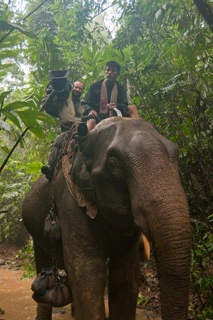
So the picture of me above shows me standing by my hedge in Redland – about to head south down Whiteladies Road, a gruelling fifteen-minute trek to the BBC offices here in Bristol.  The editor of this blog has threatened to add another photo of me in more adventurous days – crossing a river in the Congo on the trail of jungle elephants… But my shtick these days is purely vicarious adventure.

Brian being adventurous in the Congo (couldn't resist. Ed)

Brian being adventurous in the Congo (couldn't resist. Ed)


This website is made by BBC Worldwide

More from BBC Worldwide