Posts Tagged ‘Qaanaaq’

Land of the midnight sun

by Willow Murton, Assistant Producer, Arctic/Mountains team

“Wake up Willow!” shouts a voice.

I pull off my eye mask and open my eyes. The sun shines bright above me. I look at my watch.  Three o’clock in the morning?  I sit bolt upright, lifting my head from the make do pillow.   Reindeer hair sticks to my cheek.   Simon the sound recordist mutters as he rigidly stares out ahead of us.   Beth the researcher alongside us is, like me, struggling with sleep deprivation and the daylight.  I am still trying to focus my eyes in the dazzling night of the Arctic summer.  Suddenly I see the figures along the ice edge.  Five men, spread out along the horizon, all poised, waiting…watching for their target.

Willow's narwhal blog willow sleeping lores 007

Simon (Forrester) and I just before our sudden awakening

Simon swears.  We aren’t hunters but we know the rules.  We mustn’t do anything, we mustn’t move, cannot move from our dogsled bed.  I spot our tripod and camera, no cameraman anywhere nearby.  I am filled with a dreadful nauseous realisation – this could be the moment that we have spent over a year working towards.  Months of careful negotiations and awkward logistics all for us to sleep through our only possible chance of filming a narwhal hunt.  We can only sit and watch in confused disbelief… At that moment, the silhouette of a whale crests the ice edge. I wonder how on earth I am going to explain this to the team back in Cardiff…

Our camp

Our camp

Surreal scenes like this are surely what you are supposed to wake from rather than wake up to.  It’s late Spring in Northern Greenland , there is no reference to time as the sun never sets so the days blend into each other. In the full glare of the midnight sun this is a place where anything seems possible and where dreaming and being seem to meet.

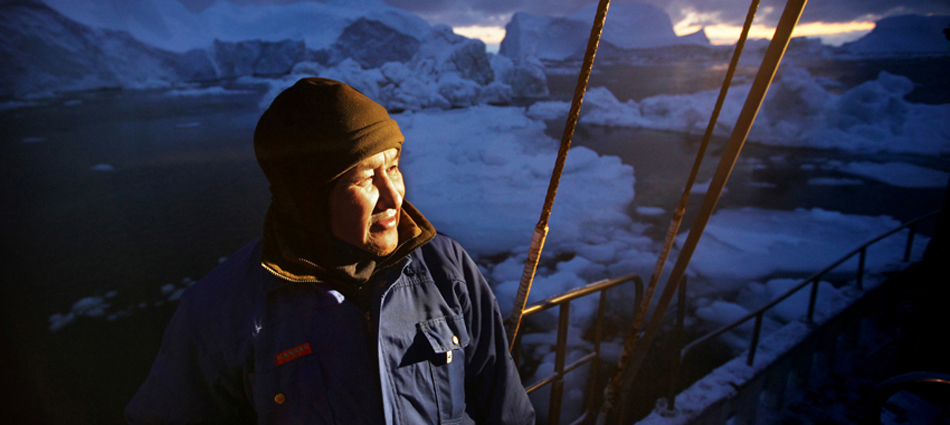
The landscape itself is constantly changing as the sea ice melts and the winds reshape it continually.  One morning it is a distant horizon and the next it reappears broken against the floe edge like shattered glass.  Weeks of watching ice charts are no preparation for what life on the ice demands.  We are four hours from the town of Qaanaaq and a world away from the scientific maps of metereology.  The brothers we are filming read the ice because they have learnt that their lives depend on it.

Our camp in the distance beside the melting ice edge

Our camp in the distance beside the melting ice edge

Our camp of six sleds is set on a floating platform of ice, around five metres thick.  We must always be ready to move in case the ice cracks and we find ourselves adrift in the freezing  Arctic Ocean.   All the hunters have a warning tale to tell.  We live between the anxiety of the hunt and the ice watch and the monotony of no day and night and the constant of rehydrated food rations.  We put sun cream on at two in the morning and wear sunglasses in our sleeping bags.  We laugh with the hunters, with each other, to ourselves. We develop our own ways of dealing with the daylight and the long hours of nervous despair waiting for invisible whales to return.

A surreal, ever-changing landscape

A surreal, ever-changing landscape

What happened next after that first daylit night on the ice edge, only the film can tell.  Finally coming back to the predictable shades of the British summer was itself like awakening from a distant dream.

Dale Templar – Series Producer

dale_templar_2lowres

I think I have already moaned about the British Summer in an earlier blog, and believe me it’s easy to moan.  Reading Willow’s account of summer life in Greenland does make we remember how lucky we are here in the UK.  Living with 24 hour sunlight is really strange and does mess with your head and sleep patterns.  I was lucky enough to spend time in Antarctica filming penguins – the cameraman and I had to wait until 3.30am to film the sunset! The flip side however is far worse;  there are many communities in the Arctic as well as the scientists down South, who have to spend months of the year in total darkness.  That would totally do my head in!   I would suffer from SAD (Sunlight Affective Disorder)  and seriously go mad!

I was talking this week to a producer from Glasgow.  Apparently SAD is a real problem there and the Scottish Government is considering handing out vitamin D to people because of the lack of sunlight in the winter months. So, can you imagine what it must be like in Greenland?  Anyway, I’m looking forward to viewing footage from central Africa next week.  Now there’s a great place to be, 12 hours of darkness and 12 hours of sunshine, the perfect mix for film makers.


Teams everywhere on location

 (C) Ellen Davies / BBC Human Planet

by Ellen Davies, Production Manager, Arctic/Mountains team

My location is Cardiff and my office is on the top floor of BBC Wales which overlooks Llandaff Cathedral.   Here I  enjoy the comforts of my work place where so many of our day to day facilities are taken for granted.   I’m comfortable.  One of my  teams are currently in Greenland, the other is about to head off to Mongolia (for more see below my blog).   Geoff from BBC Shipping has a very soft, gentle voice and says: “Calm.  Calm.”   It works.   I’m now calmer and I’m in the process of freighting my second shipment of kit to Qaanaaq, the most northern town in Greenland.   Geoff simplifies the process.

We hire, purchase, gather and pack our kit with our wonderful Patrick Murray, Cardiff’s Technical Assistant on Human Planet (what would we do without Patrick?).   For Greenland this includes a crane with hothead, a kayak with specially designed rig, camping gear, cameras, sound, first aid kit and enough warm clothes and sleeping bags to make sure the crew don’t freeze.

(C) Ellen Davies / BBC Human Planet

Ellen and Patrick and kit bound for the Arctic

Getting the kit to our destination is quite straightforward – from Heathrow to Copenhagen to Kangerlussuaq to Illulissat to Pituffik to Qaanaaq and onto Siorapualuk.   Easy.   (I can even pronounce these names now!)   The kit gets there.   It takes two days.   The last ride is by helicopter where you would fly along the rocky coast line over icebergs and fiords.   It must be pretty spectacular.   The third shipment of kit travels with the crew and I’ve only booked a seven seater people carrier to transport three people and kit!   Where and how do we accumulate so much?  We’ve now exceeded over 1000 kgs of kit.  The Arctic crew are out of the door and I’m already on the next shoot for the Mountains programme….

My Greenland team are filming two stories for the Arctic episode and one involves filming on sea ice that is starting the break up.   Because of the dangers of trying to film the narwhals (sea unicorns) from the kayak and on the ice edge, we have a strict protocol – Bethan Evans (researcher) or Nicolas Brown  (producer/director) must call me at 16.00 hrs daily.   If I don’t hear from them after four hours, I then make contact to their local police.   I look forward to my cup of tea after I’ve received their phone call.   I can relax for another day.   My schedule and two mobile phones rest on my bed side table and I warn my husband that I might just get a call.   I put my phones on silent but vibrate.

Sometimes I wish I was the one going on  these amazing filming trips but generally  I enjoy being on the end of a satellite phone, the welcome voice of home for the guys on location.  By working on this series I’ve really come to understand the incredible way people live in these remote environments.   More than ever I appreciate the comforts of my home, my family and friends and the BBC office.   Roll on 2011, when I will enjoy watching the fantastic footage and amazing stories on my 52” plasma screen in HD!

dale on volcano lowres

Dale Templar, Series Producer, A Return to the Last Disco in Mongolia

I don’t get out much these days, one of the few down sides of running Human Planet.   On Sunday I am due to return to Mongolia to film golden eagle  nests. I say “due” because I’ve just had a phone call from Dina, our researcher,  to say the eagle chicks we wanted to film have been taken!   Poor Dina!  As I write, there are men on horses galloping around the western Mongolia mountains looking for eagle nests.  They are seven hours ahead and if there is no joy soon we may have to cancel the shoot. 

Anyway, back to my original story.   If we do fly on Sunday this will be a strange return.   The last time I filmed in Mongolia was in 1993, soon after Russia pulled out of the country.   It ‘s still one of the most God forsaken places I have ever visited.   The economic rug had been pulled from underneath the country – they’d been left abandoned.   Ulaanbaator was a sad, bleak capital city filled with stark Stalinist buildings, empty shops, abandoned hospitals and truly disgusting food.   No longer needed as a buffer zone with China, they’d been left to start again.

I had gone to make a film with Fergal Keane about the sewer children and spent a fair bit of time underneath the rat ridden streets of the capital.  We had knives pulled on us, stones thrown at us,  sewer covers slammed on us……. umm Mongolia, can’t wait to return.   Thank goodness for the disco at the Ulaanbaatar Hotel ! 

Seventeen years on,  I’m told Mongolia has changed significantly.   I actually can’t wait to see it.  The boy I filmed was called Batzayan, he will now be a man.   Hopefully he will be successfully forging his way,  feeding his children and keeping them warm as this now established democracy pushes open the doors of the market economy.


This website is made by BBC Worldwide

More from BBC Worldwide