<?xml version="1.0" encoding="UTF-8"?>
<rss version="2.0"
	xmlns:content="http://purl.org/rss/1.0/modules/content/"
	xmlns:wfw="http://wellformedweb.org/CommentAPI/"
	xmlns:dc="http://purl.org/dc/elements/1.1/"
	xmlns:atom="http://www.w3.org/2005/Atom"
	xmlns:sy="http://purl.org/rss/1.0/modules/syndication/"
	xmlns:slash="http://purl.org/rss/1.0/modules/slash/"
	>

<channel>
	<title>BBC Human Planet</title>
	<atom:link href="http://www.humanplanetblog.com/?feed=rss2" rel="self" type="application/rss+xml" />
	<link>http://www.humanplanetblog.com</link>
	<description>Just another WordPress site</description>
	<lastBuildDate>Wed, 04 May 2011 09:33:03 +0000</lastBuildDate>
	<language>en</language>
	<sy:updatePeriod>hourly</sy:updatePeriod>
	<sy:updateFrequency>1</sy:updateFrequency>
	<generator>http://wordpress.org/?v=3.1</generator>
		<item>
		<title>The Original Jungle and its Mighty Beasts</title>
		<link>http://www.humanplanetblog.com/?p=1950&#038;utm_source=rss&#038;utm_medium=rss&#038;utm_campaign=the-original-jungle-and-its-mighty-beasts</link>
		<comments>http://www.humanplanetblog.com/?p=1950#comments</comments>
		<pubDate>Wed, 04 May 2011 09:17:44 +0000</pubDate>
		<dc:creator>simapatel</dc:creator>
				<category><![CDATA[Uncategorized]]></category>
		<category><![CDATA[BBC]]></category>
		<category><![CDATA[BBC Earth]]></category>
		<category><![CDATA[human planet]]></category>
		<category><![CDATA[jungles]]></category>

		<guid isPermaLink="false">http://www.humanplanetblog.com/?p=1950</guid>
		<description><![CDATA[By Rachel Kinley, Assistant Producer of Human Planet The word Jungle itself comes from the Sanskrit word for forest. It was in this original jungle, on the borders between India and Burma, that we filmed people working with one the most iconic of jungle animals – the forest elephant. It took us three days and several [...]]]></description>
			<content:encoded><![CDATA[<p>By Rachel Kinley, Assistant Producer of Human Planet</p>
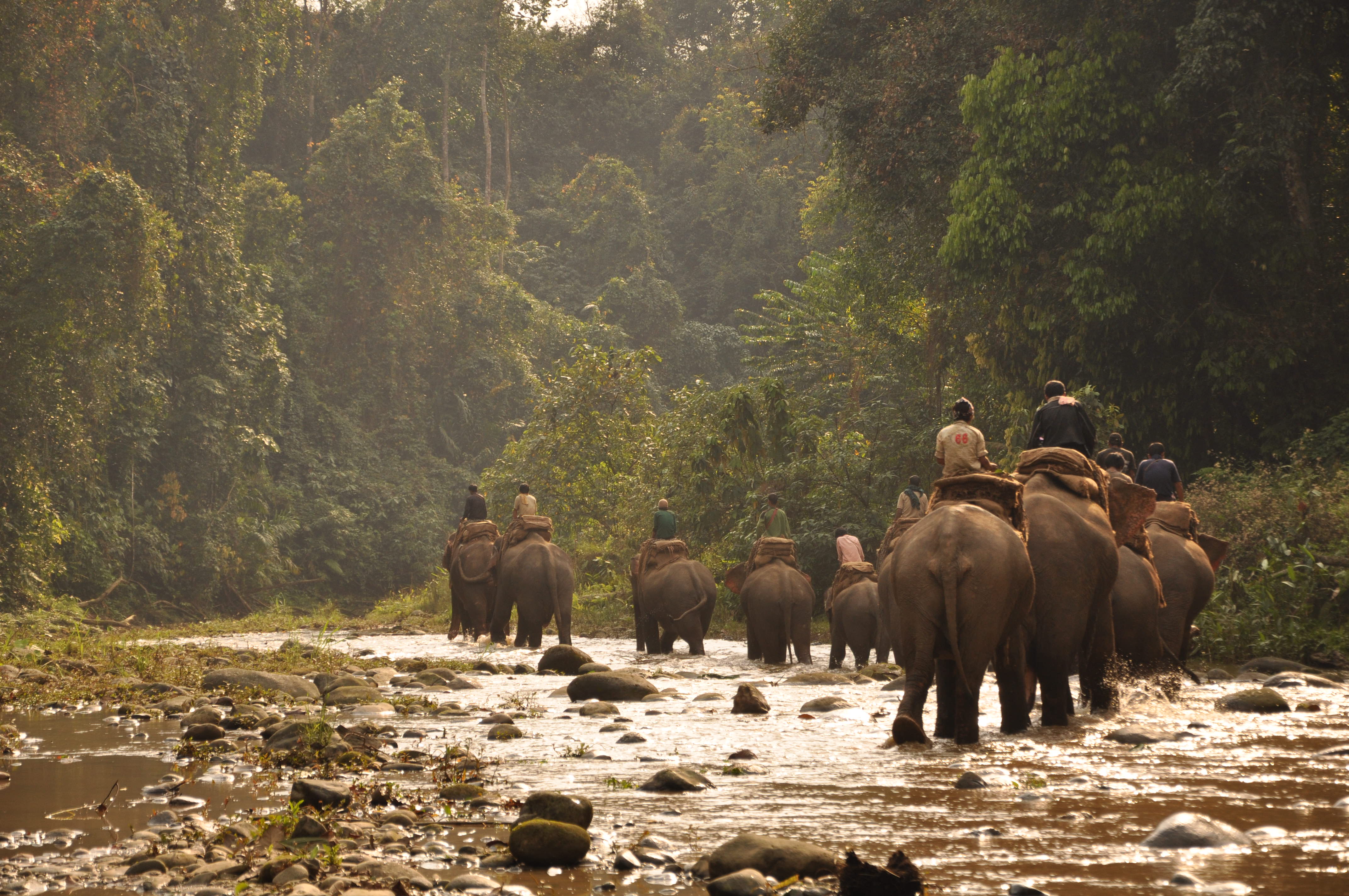
<p>The word Jungle itself comes from the Sanskrit word for forest. It was in this original jungle, on the borders between India and Burma, that we filmed people working with one the most iconic of jungle animals – the forest elephant.</p>
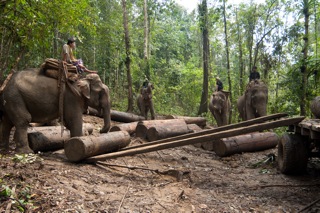
<div id="attachment_1953" class="wp-caption alignnone" style="width: 310px"><a href="http://www.humanplanetblog.com/wp-content/uploads/2011/05/HP_Jng_IndEle_RK_0031.jpg"><img class="size-medium wp-image-1953" title="HP_Jng_IndEle_RK_0031" src="http://www.humanplanetblog.com/wp-content/uploads/2011/05/HP_Jng_IndEle_RK_0031-300x199.jpg" alt="" width="300" height="199" /></a><p class="wp-caption-text">Elephants returning back to camp © Rachael Kinley</p></div>
<p>It took us three days and several forms of transport, including a rickety old logging truck, to reach the camp which would be our home for the next two weeks. There wasn’t just us staying there though, this camp was home to a dozen elephants and their mahouts.</p>
<p>We were there to film them moving felled trees from the forest, as part of a sustainable logging business.  Watching the elephants at work was so impressive. They are powerful beasts who can move a massive log as if it was a tiny twig. Amazing!</p>
<div id="attachment_1955" class="wp-caption alignnone" style="width: 310px"><a href="http://www.humanplanetblog.com/wp-content/uploads/2011/05/HP-Blog-Elephant-Logging-5.jpeg"><img class="size-medium wp-image-1955" title="HP Blog - Elephant Logging-5" src="http://www.humanplanetblog.com/wp-content/uploads/2011/05/HP-Blog-Elephant-Logging-5-300x199.jpg" alt="" width="300" height="199" /></a><p class="wp-caption-text">Loading the logging truck © Mihali Moore</p></div>
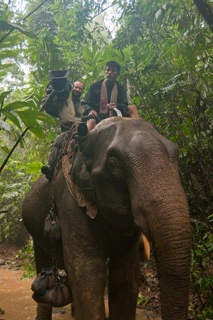
<p>Being so strong, they really intimidated me at first.  After we’d filmed with them for a while though, I realised that that their mahouts were well in control of these animals. So, when I was offered the chance, I jumped at the opportunity to take one for a ride. I was only allowed to travel on the female elephants so as not to spook the bulls. Our cameraman Robin however was game to ride any elephant any which way, and even learnt how to steer it along with his feet!</p>
<div id="attachment_1952" class="wp-caption alignnone" style="width: 209px"><a href="http://www.humanplanetblog.com/wp-content/uploads/2011/05/HP-Blog-Elephant-Logging-13.jpeg"><img class="size-medium wp-image-1952" title="HP Blog - Elephant Logging-13" src="http://www.humanplanetblog.com/wp-content/uploads/2011/05/HP-Blog-Elephant-Logging-13-199x300.jpg" alt="" width="199" height="300" /></a><p class="wp-caption-text">Robin preparing to film on the back of Ramprasad © Mihali Moore</p></div>
<p><a href="http://www.humanplanetblog.com/wp-content/uploads/2011/05/HP-Blog-Elephant-Logging-13.jpeg"></a>Spending time with these mahouts who dedicate their lives to looking after these animals was an empowering experience. This sequence really shows that the Human Planet Jungles programme isn’t just about living in rainforests, it’s about the incredible relationships people have with their environment and the species which live within.</p>
<p>The Human Planet Jungles and Grasslands episode can be seen on the Discovery Channel.</p>
<p>&nbsp;</p>
]]></content:encoded>
			<wfw:commentRss>http://www.humanplanetblog.com/?feed=rss2&#038;p=1950</wfw:commentRss>
		<slash:comments>0</slash:comments>
		</item>
		<item>
		<title>The Making Rivers and Oceans</title>
		<link>http://www.humanplanetblog.com/?p=1933&#038;utm_source=rss&#038;utm_medium=rss&#038;utm_campaign=the-making-rivers-and-oceans</link>
		<comments>http://www.humanplanetblog.com/?p=1933#comments</comments>
		<pubDate>Thu, 21 Apr 2011 14:06:07 +0000</pubDate>
		<dc:creator>simapatel</dc:creator>
				<category><![CDATA[Uncategorized]]></category>

		<guid isPermaLink="false">http://www.humanplanetblog.com/?p=1933</guid>
		<description><![CDATA[Renee Godfrey, Assistant Producer on Human Planet, explains her favourite part of making Rivers and Oceans. One of the most magical ways of living with rivers is found in the Khasi Hills of North East India; an environment, during monsoon season, engulfed by raging rivers. Searching for the secrets the deep Khasi tribal valleys and [...]]]></description>
			<content:encoded><![CDATA[<p>Renee Godfrey, Assistant Producer on Human Planet, explains her favourite part of making Rivers and Oceans.</p>
<p><a href="http://www.humanplanetblog.com/wp-content/uploads/2011/04/LI1198320@Timothy_Allen_151.jpg"><img class="alignnone size-full wp-image-1940" title="LI1198320@Timothy_Allen_151" src="http://www.humanplanetblog.com/wp-content/uploads/2011/04/LI1198320@Timothy_Allen_151.jpg" alt="" width="573" height="382" /></a></p>
<p>One of the most magical ways of living with rivers is found in the Khasi Hills of North East India; an environment, during monsoon season, engulfed by raging rivers. Searching for the secrets the deep Khasi tribal valleys and villages hold is a dream come true for any adventurous film maker.</p>
<p>Once a part of Assam in Northeast India, the tropically lush and verdant massif of Meghalaya stands proudly above the pancake flat plains of Bangladesh. As the Southwest Indian monsoon moves its moisture laden way up the Bay of Bengal and over Bangladesh, the Khasi Hills are the first major landmass it meets. Huge teams of nimbostratus clouds tower and linger with excited intent at having reached their destination – one of the wettest places on our planet.</p>
<p>With each twist and turn of the road, new and magnificent vistas are revealed. There is an air of mystery to the geography – its tropical forest draped in orchids, misty ridges, impossibly steep and seemingly inaccessible gorges, and moody rivers all begging to be explored.</p>
<p>During monsoon, the Khasi are faced with dealing with biblical amounts of water falling from the sky. Their traditional villages magically appear from nowhere through the enchanted forest, all cope wonderfully with days of downpours.</p>
<p>While the crew are all kitted out with umbrellas and waterproof jackets, Khasi society is lacking in such Gortex items, rather the women weave curved bamboo and palm leaf rain shields or ‘knub’ to protect themselves from the beatings of rain. There is also one, very unique and magical Khasi solution to coping with the rainfall; one that the Khasi are particularly proud of, and that is what I have come in search for.</p>
<p>During monsoon, the rivers intersecting Khasi villages swell greedily and become raging rapids washing away anything in their path. Faced with the problem that man made bridges and walkways of concrete or wood rot and are destroyed by the forces of water, the Khasi have come up with a unique and organic architectural solution using what mother nature provides &#8211; they have learnt to make living bridges from tree roots.</p>
<p><a href="http://www.humanplanetblog.com/wp-content/uploads/2011/04/bbc_hp_bridge.jpg"><img class="alignnone size-full wp-image-1939" title="bbc_hp_bridge" src="http://www.humanplanetblog.com/wp-content/uploads/2011/04/bbc_hp_bridge.jpg" alt="" width="490" height="653" /></a><br />
Ficus elastica, or more commonly, the Indian Rubber Tree, is a loyal and useful character in the colourful cast within the forest canopy. Perched wisely on huge boulders or alongside riverbanks, the ficus trees sit, adorned with party streamer like aerial roots. Each root shoots out in medusa style fashion, on a mission to find soils with greater stability. Well rehearsed in the shifting moods and flows of the rivers, the help of these loyal root tendrils keeps the ficus trees standing strong. By encouraging the aerial roots across impassable rivers and gorges, bridges form and areas once impassable became accessible.</p>
<p>To find the root bridges takes dedication and concentration. An impossibly steep and knee numbing descent takes me down through layers of forest into the enchanted Khasi world.</p>
<p>Local villagers have made tiny steps down the steep gorge slopes, plunging into the heart of the forest &#8211; hundreds upon thousands of pebbles smoothed by years of Khasi feet trotting up and down.</p>
<p>Each pebble marked by footprints of times past, each with stories to tell as they take the weight of the local tribes.</p>
<p>As I hop across streams, sway dramatically over rickety steel bridges with heart in throat, too scared to look down at the white water below, my curiosity drives me on. These bridges of ornate organic architecture are hidden within this fairytale forest and these endless paths will, I know, eventually unveil their wonder.</p>
<p>Three hours into the trek, a small perfectly manicured village, Nogkriet appears at the end of the steps. Just beyond Nongkriet, I look up and am transported into an unbelievable scene; a mix between Alice in Wonderland and Lord of the Rings – colourful spiders look on from silvery webs and at any minute I expect to see fairies dancing around the bamboos. There in all its magical glory is the 200 year old Umshiang double decker root bridge. Sitting with an omnipotent grace, the bridge is bejewelled in aerial roots of all shapes, ages and textures – like a Monarch draped in regal gold – the ficus; treasure is equally as impressive and precious.</p>
<p><a href="http://www.humanplanetblog.com/wp-content/uploads/2011/04/bbc_hp_bridges.jpg"><img class="alignnone size-full wp-image-1938" title="bbc_hp_bridges" src="http://www.humanplanetblog.com/wp-content/uploads/2011/04/bbc_hp_bridges.jpg" alt="" width="653" height="490" /></a><br />
The Khasi of Nonkriet village have trained the roots of one single ficus tree on two levels across the river; the result, a surreal double decker root bridge sketched into the forest landscape like some sort of magical computer generated graphic on mother nature’s stunningly crafted film set; nature’s magic.</p>
<div class="mceTemp">
<dl id="attachment_1941" class="wp-caption alignnone" style="width: 546px;">
<dt class="wp-caption-dt"><a href="http://www.humanplanetblog.com/wp-content/uploads/2011/04/bbc_hp_group.jpg"><img class="size-full wp-image-1941 " title="bbc_hp_group" src="http://www.humanplanetblog.com/wp-content/uploads/2011/04/bbc_hp_group.jpg" alt="" width="536" height="356" /></a></dt>
<dd class="wp-caption-dd">Renee Godfrey getting to know the local Khasi women.  &#8217;the local women pass by on their way to the rice paddies and stop to stand and stare with as much wonder for the blonde haired foreigner, as the foreigner has for their root bridges!&#8217;</dd>
</dl>
</div>
<p>&nbsp;</p>
]]></content:encoded>
			<wfw:commentRss>http://www.humanplanetblog.com/?feed=rss2&#038;p=1933</wfw:commentRss>
		<slash:comments>0</slash:comments>
		</item>
		<item>
		<title>The Great American Grassland</title>
		<link>http://www.humanplanetblog.com/?p=1929&#038;utm_source=rss&#038;utm_medium=rss&#038;utm_campaign=the-great-american-grassland-3</link>
		<comments>http://www.humanplanetblog.com/?p=1929#comments</comments>
		<pubDate>Thu, 14 Apr 2011 11:42:43 +0000</pubDate>
		<dc:creator>adrian</dc:creator>
				<category><![CDATA[Uncategorized]]></category>

		<guid isPermaLink="false">http://www.humanplanetblog.com/?p=1929</guid>
		<description><![CDATA[by Brian Leith, Executive Producer of Human Planet Choosing which stories to film for Human Planet was demanding: ideally we wanted to show our audiences something new and surprising – something they’d never seen before. That’s why we often went for dramatic eye-popping moments from half-way around the world&#8230;but there were also times when we [...]]]></description>
			<content:encoded><![CDATA[<p>by Brian Leith, Executive Producer of <em>Human Planet</em></p>
<p>Choosing which stories to film for <em>Human Planet</em> was demanding: ideally we wanted to show our audiences something new and surprising – something they’d never seen before. That’s why we often went for dramatic eye-popping moments from half-way around the world&#8230;but there were also times when we could have chosen stories from right under our noses – stories which we’d all heard about, but which were just as amazing as anything you’d find 10,000 miles away.</p>
<p>For the Grasslands episode I kept thinking about a filming trip I’d made 15 years ago in one of America’s most beautiful – if surprising – landscapes: the high plains of Oklahoma and Kansas. This was the old ‘dustbowl’ country of the 1930s, the flat-as-a-pancake lands which had been settled in the late 19th and early 20th century with grants of free land to anyone prepared to try and make a living there.<br />
And the settlers came! Those were troubled years in Europe and tens of thousands of immigrants came to this promised land, grateful to have the chance to make an honest living growing their own crops on their own land, enjoying freedom and the open-armed welcome of their newly adopted nation.</p>
<p>But it wasn’t easy. This was also a brutal land – suffering extremes of weather and climate on top of a thin soil which (if truth be told) was never really going to support much wheat or livestock. It was classic <em>Human Planet</em>: people pushed to the very limits of their ingenuity and bravery, attempting to forge a life for themselves in the most trying of circumstances.<br />
And we all know what happened. The winds came, the topsoil blew away, and grasslands that were never really capable of growing vast fields of grain on such an intensive scale turned to dust, along with the dreams of those settlers, many of whom were forced to move on westwards towards another promised land.</p>
<p>But that’s not the end of the story.</p>
<p>The people I met on those plains 15 years ago were the descendants of the dustbowl survivors – the ones who’d stayed and stuck it out.  They’re among the most impressive people I’ve ever met: hard-working and determined, people who know their land – its potential and its limitations – much better than most of us. They are as impressive survivors as anyone we filmed for <em>Human Planet</em>.</p>
<p>I’m often struck by how it’s just such people &#8211; with tough lives – who often show the greatest generosity and kind-heartedness. I made one or two friends on that filming trip who remain friends to this day: people who persuaded me to stay and enjoy a good meal and a conversation rather than drive back to my distant motel.</p>
]]></content:encoded>
			<wfw:commentRss>http://www.humanplanetblog.com/?feed=rss2&#038;p=1929</wfw:commentRss>
		<slash:comments>0</slash:comments>
		</item>
		<item>
		<title>When Explorers Collide</title>
		<link>http://www.humanplanetblog.com/?p=1910&#038;utm_source=rss&#038;utm_medium=rss&#038;utm_campaign=a-post-from-human-planet-editor-dina</link>
		<comments>http://www.humanplanetblog.com/?p=1910#comments</comments>
		<pubDate>Thu, 07 Apr 2011 12:21:58 +0000</pubDate>
		<dc:creator>simapatel</dc:creator>
				<category><![CDATA[The Team]]></category>

		<guid isPermaLink="false">http://www.humanplanetblog.com/?p=1910</guid>
		<description><![CDATA[by Dina Mufti, Assistant Producer on Mountains/Education Producer of Human Planet After Human Planet took the UK by storm, the series is now coming to the US this Sunday on Discovery at 8pm. We are so excited about the US launch and we hope you will enjoy watching the series just as much as we [...]]]></description>
			<content:encoded><![CDATA[<p>by Dina Mufti, Assistant Producer on Mountains/Education Producer of Human Planet</p>
<div>
<dl id="attachment_1878"></dl>
</div>
<p>After Human Planet took the UK by storm, the series is now coming to the US this <strong><a href="http://dsc.discovery.com/tv/human-planet/">Sunday on Discovery at 8pm</a></strong>. We are so excited about the US launch and we hope you will enjoy watching the series just as much as we enjoyed making it. We&#8217;ve so many production tales to tell I wanted to share with you why having the chance to work on the Human Planet project is so rewarding for me personally. I was 11 years old and I was walking through the cobbled streets of Lisbon holding my father&#8217;s hand looking for the tomb of Vasco da Gama. In 1497 the great Portuguese explorer had set sail with his crew in search of the end of the world. I can recollect looking up at his tomb as my father explained all this to me and from that moment on I wanted to travel.</p>
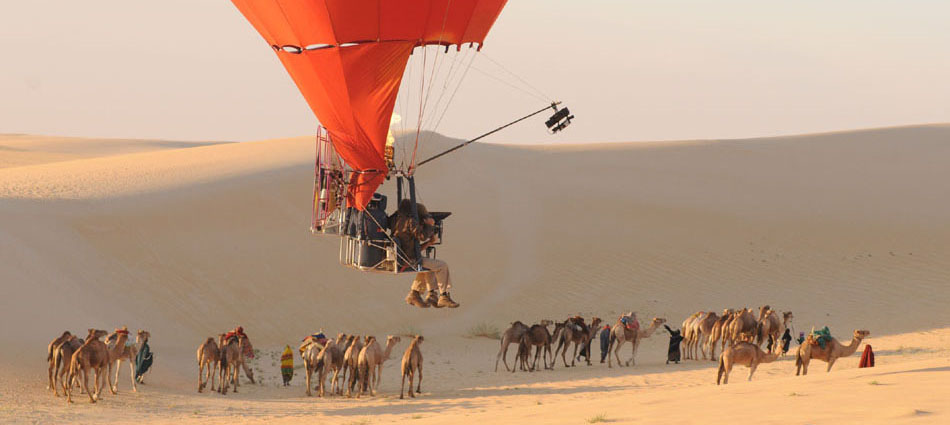
<div id="attachment_1912" class="wp-caption alignnone" style="width: 403px"><a href="http://www.humanplanetblog.com/wp-content/uploads/2011/04/HP_Des_Tubu_CH_0031.jpg"><img class="size-full wp-image-1912" title="Cecilia and Tuppence" src="http://www.humanplanetblog.com/wp-content/uploads/2011/04/HP_Des_Tubu_CH_0031.jpg" alt="" width="393" height="590" /></a><p class="wp-caption-text">Human Planet production team members Tuppence Stone and Cecilia Hue with 10 year old Shede, a Tubu girl who crosses the Sahara in a camel train searching for water - featured in the geography class films.</p></div>
<p>When I came home my geography classes at school took on a whole new meaning. The maps and photographs of mysterious people around the world became three dimensional, brought to life by my dream of sailing with Vasco da Gama discovering the world and its diverse characters. My father had used a clever trick &#8211; by enlivening my imagination, my geography classes suddenly became exciting and I wanted to learn more. The way people lived their lives around the world and the different environments they lived in became more intriguing and, most essentially, became connected to my own.</p>
<div id="attachment_1913" class="wp-caption alignnone" style="width: 453px"><a href="http://www.humanplanetblog.com/wp-content/uploads/2011/04/Dina-Eagle-and-Boy.jpg"><img class="size-full wp-image-1913" title="Dina and Eagle" src="http://www.humanplanetblog.com/wp-content/uploads/2011/04/Dina-Eagle-and-Boy.jpg" alt="" width="443" height="590" /></a><p class="wp-caption-text">Dina Mufti on location in Western Mongolia with and 16 year old Berik, a Kazakh Eagle Hunter. </p></div>
<p>Passing on knowledge that opens the minds of young people &#8211; from a father to a daughter or as a programme maker to an audience &#8211; is one of the richest rewards in life. So when I was asked to re-edit some of the Human Planet stories that you&#8217;ll see in the series for geography classes in schools, old da Gama and I brushed the dust off the sails and were on our way again. And we had a gift &#8211; this time the pictures were not painted by flat maps and text book descriptions but by the awe-inspiring footage from the Human Planet series.</p>
<div id="attachment_1914" class="wp-caption alignnone" style="width: 600px"><a href="http://www.humanplanetblog.com/wp-content/uploads/2011/04/Dina-in-Edit-Suite.jpg"><img class="size-full wp-image-1914" title="Dina in Edit Suite" src="http://www.humanplanetblog.com/wp-content/uploads/2011/04/Dina-in-Edit-Suite.jpg" alt="" width="590" height="394" /></a><p class="wp-caption-text">Dina Mufti in the Human Planet edit suite.</p></div>
<p>Through central characters children will be guided through genuine experiences and learn valuable lessons about survival and management within our changing environment. From their classrooms they can begin to voyage &#8211; and ask important questions that will affect their future and shape the world they live in. Like me, padding across those cobbled streets so long ago, they can become explorers &#8211; and set sail with Vasco da Gama… something tells me he would be pretty happy about that…</p>
<div id="attachment_1911" class="wp-caption alignnone" style="width: 600px"><a href="http://www.humanplanetblog.com/wp-content/uploads/2011/04/Ethiopia.jpg"><img class="size-full wp-image-1911" title="Ethiopia" src="http://www.humanplanetblog.com/wp-content/uploads/2011/04/Ethiopia.jpg" alt="" width="590" height="393" /></a><p class="wp-caption-text">Wherever the Human Planet crew travelled, children were constantly curious. Omo Valley, Ethiopia.</p></div>
<p><strong><a href="http://dsc.discovery.com/tv/human-planet/">Human Planet comes to US on the Discovery Channel at 8pm on April 10th.</a></strong></p>
]]></content:encoded>
			<wfw:commentRss>http://www.humanplanetblog.com/?feed=rss2&#038;p=1910</wfw:commentRss>
		<slash:comments>0</slash:comments>
		</item>
		<item>
		<title>The End and the Beginning of Human Planet</title>
		<link>http://www.humanplanetblog.com/?p=1859&#038;utm_source=rss&#038;utm_medium=rss&#038;utm_campaign=the-end-and-the-beginning-of-human-planet</link>
		<comments>http://www.humanplanetblog.com/?p=1859#comments</comments>
		<pubDate>Wed, 09 Mar 2011 16:38:49 +0000</pubDate>
		<dc:creator>Julia Wellard</dc:creator>
				<category><![CDATA[On Location]]></category>
		<category><![CDATA[BBC; Human Planet;]]></category>
		<category><![CDATA[Dale Templar]]></category>
		<category><![CDATA[Dorobo]]></category>
		<category><![CDATA[grasslands]]></category>
		<category><![CDATA[oceans]]></category>
		<category><![CDATA[Timothy Allen]]></category>
		<category><![CDATA[Timothy Allen photographer]]></category>

		<guid isPermaLink="false">http://humanplanet.blogs.bbcearth.com/?p=1859</guid>
		<description><![CDATA[by Dale Templar, Series Producer Last Thursday saw the final episode of Human Planet transmit in the UK.  I had mixed feelings as I watched the end credits roll for the last time.  After three intense years, sending teams to over 70 locations including some of the remotest places on earth, this really did mark [...]]]></description>
			<content:encoded><![CDATA[<p>by Dale Templar, Series Producer</p>
<div id="attachment_1878" class="wp-caption aligncenter" style="width: 600px"><img class="size-medium wp-image-1878   " title="Dale on a shoot in Mongolia for the Eagle Hunters sequence which was filmed for the Mountains programme." src="http://77.68.47.12/bbchumanplanet/wp-content/uploads/2011/03/dsc0150.jpg?w=590" alt="" width="590" height="391" /><p class="wp-caption-text">Dale pictured in Mongolia on a shoot to film the Eagle Hunters sequence from the Mountains programme. </p></div>
<p>Last Thursday saw the final episode of Human Planet transmit in the UK.  I had mixed feelings as I watched the end credits roll for the last time.  After three intense years, sending teams to over 70 locations including some of the remotest places on earth, this really did mark the end of the formal production process on the series.  It is always sad when a production ends.  Virtually all of my amazingly talent team have gone &#8211; many already on new adventures around the world.  There is literally just a handful of us left in the Bristol and Cardiff offices.</p>
<div id="attachment_1863" class="wp-caption aligncenter" style="width: 600px"><a rel="attachment wp-att-1863" href="http://humanplanet.blogs.bbcearth.com/2011/03/09/the-end-and-the-beginning-of-human-planet/hp-team-photo_tallen-lowres/"><img class="size-medium wp-image-1863 " title="Dale with some of the Human Planet team. From left - right (front) Edit Assistant Craig Haywood, (Dale), Technical Co-ordinator Jasper Montana, Production Co-ordinator Isabelle Corr, Production Manager Alison Brown-Humes. (Back) Production Management Assistant Julia Wellard, Production Co-ordinator Jo Manley" src="http://77.68.47.12/bbchumanplanet/wp-content/uploads/2011/03/hp-team-photo_tallen-lowres.jpg?w=590" alt="" width="590" height="393" /></a><p class="wp-caption-text">Dale with some of the Human Planet team. From left - right (front) Edit Assistant Craig Haywood, (Dale), Technical Co-ordinator Jasper Montana, Production Co-ordinator Isabelle Corr, Production Manager Alison Brown-Humes. (Back) Production Management Assistant Julia Wellard, Production Co-ordinator Jo Manley (Photo copyright Timothy Allen 2010)</p></div>
<p>But Human Planet has been different from any other programme I have ever worked on.  Normally the last UK transmission would be the end of the series.  For Human Planet it feels like a new beginning.  For a start I am still in slight shock at the amazingly intense and positive reaction we have had to the series from people of all age groups.  The series has been praised by  members of the Royal Geographical Society, it&#8217;s been the focus of talk and gossip around office water coolers and it&#8217;s been making news particuarly online.  I&#8217;m especially pleased that the series has  connected with a younger audience &#8211; there&#8217;s  been a buzz on Twitter and Facebook and millions of hits on You Tube.  One young mum  told me her 3 year old son was a huge fan of Human Planet, watching every episode without fail!  No programme maker can ever be sure of a hit.  This is a very fickle industry and audiences can never be guaranteed even when you&#8217;ve made a landmark series for the BBC.  The feeling is that Human Planet is a fresh and different type of landmark.  Many people, even those who don&#8217;t normally enjoy natural history have become hooked on humans!</p>
<div class="mceTemp mceIEcenter">
<div id="attachment_1868" class="wp-caption aligncenter" style="width: 403px"><a rel="attachment wp-att-1868" href="http://humanplanet.blogs.bbcearth.com/2011/03/09/the-end-and-the-beginning-of-human-planet/last-one-2/"><img class="size-medium wp-image-1868" title="Dorobo hunter Rakita from our Grasslands programme who's hunting traditions are being stopped by Kenyan law. Human Planet captured them stealing a lion's kill, something that possibly might not be seen again. (Copyright Jane Atkins/BBC)" src="http://77.68.47.12/bbchumanplanet/wp-content/uploads/2011/03/last-one.jpg?w=393" alt="" width="393" height="590" /></a><p class="wp-caption-text">Dorobo hunter Rakita from our Grasslands programme who&#039;s hunting traditions are being stopped by Kenyan law. Human Planet captured them stealing a lion&#039;s kill, something that possibly might not be seen again. (Copyright Jane Atkins/BBC)</p></div>
</div>
<p>Personally I hope this new found passion for humanity will continue.  The series is a spectacular snapshot of the diverse human world we live in.  But the world is changing fast, very fast.  It&#8217;s becoming increasingly hermogenised.  Even now one City looks much like the next &#8211; same Starbucks , same McDonald&#8217;s.  Human Planet filmed with people who still directly depend on the natural world for their survival but their wisdom and customs may soon be disappear.  The human species cannot be set in aspic but I think many of the stories we filmed will be gone within the next 10 years.</p>
<div class="mceTemp mceIEcenter">
<div id="attachment_1864" class="wp-caption aligncenter" style="width: 600px"><a rel="attachment wp-att-1864" href="http://humanplanet.blogs.bbcearth.com/2011/03/09/the-end-and-the-beginning-of-human-planet/oceans/"><img class="size-medium wp-image-1864  " title="Where it all began with Bajau free-diver Sulbin in our Oceans programme. More of Timothy Allen's stunning photos feature in the Human Planet book - availiable now" src="http://77.68.47.12/bbchumanplanet/wp-content/uploads/2011/03/oceans.jpg?w=590" alt="" width="590" height="331" /></a><p class="wp-caption-text">Where it all began here in the UK with Bajau free-diver Sulbin in our Oceans programme. More of Timothy Allen&#039;s stunning photos feature in the Human Planet book - availiable now.</p></div>
</div>
<p>So what next? The series is now out on DVD/Blu-Ray and the book is in the shops.  Next month it jumps across the Atlantic to be shown on Discovery Channel (a different version from the one showing in the UK)   Then the UK version will start being shown on television around the world.  So look out for Human Planet in your neck of the woods!  Hopefully the BBC will commission a second series, watch this space&#8230;</p>
<p>So hopefully the end is truly just the beginning&#8230;I can only hope that this series sparks an interest in the challenges facing our human planet and that more is done to protect the incredible diversity, languages and cultures of our magnificent species.</p>
<p>Long live the Human Planet and all that sail on her!</p>
<div id="attachment_1865" class="wp-caption aligncenter" style="width: 600px"><a rel="attachment wp-att-1865" href="http://humanplanet.blogs.bbcearth.com/2011/03/09/the-end-and-the-beginning-of-human-planet/png_timothy-allen_033-lowres/"><img class="size-medium wp-image-1865" title="A Papuan tribesmen adorned with feathers from birds of paradise from our Jungles programme (copyright Timothy Allen/BBC)" src="http://77.68.47.12/bbchumanplanet/wp-content/uploads/2011/03/png_timothy-allen_033-lowres.jpg?w=590" alt="" width="590" height="393" /></a><p class="wp-caption-text">A Papuan tribesmen adorned with feathers from birds of paradise from our Jungles programme (copyright Timothy Allen/BBC)</p></div>
]]></content:encoded>
			<wfw:commentRss>http://www.humanplanetblog.com/?feed=rss2&#038;p=1859</wfw:commentRss>
		<slash:comments>0</slash:comments>
		</item>
		<item>
		<title>Living with Lions</title>
		<link>http://www.humanplanetblog.com/?p=1771&#038;utm_source=rss&#038;utm_medium=rss&#038;utm_campaign=living-with-lions</link>
		<comments>http://www.humanplanetblog.com/?p=1771#comments</comments>
		<pubDate>Thu, 17 Feb 2011 16:18:06 +0000</pubDate>
		<dc:creator>Julia Wellard</dc:creator>
				<category><![CDATA[On Location]]></category>
		<category><![CDATA[BBC; Human Planet;]]></category>
		<category><![CDATA[Dorobo]]></category>
		<category><![CDATA[grasslands]]></category>
		<category><![CDATA[hunters]]></category>
		<category><![CDATA[Jane Atkins]]></category>
		<category><![CDATA[lions]]></category>

		<guid isPermaLink="false">http://humanplanet.blogs.bbcearth.com/?p=1771</guid>
		<description><![CDATA[by Jane Atkins, Human Planet Researcher &#8216;You see, Lions and the Dorobo, we feed each other.&#8217; &#8216;If we hunt a large animal, we take away as much as we can, but leave the rest for the lions to feed on. And sometimes the lions kill a really fat animal and we say, lets take this [...]]]></description>
			<content:encoded><![CDATA[<p>by Jane Atkins, Human Planet Researcher</p>
<p style="text-align:center;">&#8216;You see, Lions and the Dorobo, we feed each other.&#8217;</p>
<p style="text-align:center;">&#8216;If we hunt a large animal, we take away as much as we can, but leave the rest for the lions to feed on. And sometimes the lions kill a really fat animal and we say, lets take this one. It is not simple, you have to track carefully and quietly. You are scared.. thinking &#8211; will I be mauled?&#8217;</p>
<div class="mceTemp mceIEcenter">
<div id="attachment_1820" class="wp-caption aligncenter" style="width: 614px"><a rel="attachment wp-att-1820" href="http://humanplanet.blogs.bbcearth.com/2011/02/17/living-with-lions/untitled-1-6/"><img class="size-full wp-image-1820" title="The Dorobo" src="http://77.68.47.12/bbchumanplanet/wp-content/uploads/2011/02/untitled-15.jpg" alt="" width="604" height="358" /></a><p class="wp-caption-text">&#039;Once you make the decision to steal meat from lions, you have to be commited&#039; Rakita says.</p></div>
</div>
</div>
</div>
</div>
</div>
<p style="text-align:center;"><a rel="attachment wp-att-1799" href="http://humanplanet.blogs.bbcearth.com/?attachment_id=1799"></a><a rel="attachment wp-att-1801" href="http://humanplanet.blogs.bbcearth.com/2011/02/17/living-with-lions/screen-grab/"></a><a rel="attachment wp-att-1798" href="http://humanplanet.blogs.bbcearth.com/?attachment_id=1798"></a></p>
<p style="text-align:center;">&#8216;But when you are hungry and know lions have killed first &#8211; you take your chance. There are days when we eat only what the lion has killed. We live on those lion kills until we finally make our own kills.</p>
<p style="text-align:left;">When we filmed 3 Dorobo hunters stride up to 15 lions to steal from their fresh kill our hearts were in our mouths. Courageous? Ingenious? Suicidal? All of these perhaps, but this one act is undeniably impressive. The Dorobo say they are hunters just like lions. They watch lions, and how they hunt. Just as lions do, the Dorobo watch every animal on the great plains &#8211; and study each individual. Like lions they observe which ones are wounded, slower, easier to pick off. They wait and wait until the time is right to hunt. And if the lion gets there first, well the Dorobo turn that into another opportunity.</p>
<div id="attachment_1834" class="wp-caption aligncenter" style="width: 600px"><a rel="attachment wp-att-1834" href="http://humanplanet.blogs.bbcearth.com/2011/02/17/living-with-lions/untitled-1-7/"><img class="size-medium wp-image-1834" title="The lions" src="http://77.68.47.12/bbchumanplanet/wp-content/uploads/2011/02/untitled-16.jpg?w=590" alt="" width="590" height="389" /></a><p class="wp-caption-text">There are three lion prides living in the same area as the Dorobo. This 22 strong pride are just a few hundred metres from the Dorobo&#039;s regular camp.</p></div>
<p style="text-align:center;"><a rel="attachment wp-att-1833" href="http://humanplanet.blogs.bbcearth.com/2011/02/17/living-with-lions/untitled-3-2/"></a></p>
<p style="text-align:left;"><a rel="attachment wp-att-1828" href="http://humanplanet.blogs.bbcearth.com/2011/02/17/living-with-lions/untitled-3/"></a><a rel="attachment wp-att-1827" href="http://humanplanet.blogs.bbcearth.com/2011/02/17/living-with-lions/2_edited-1-2/"></a></p>
<div class="mceTemp mceIEcenter"><a rel="attachment wp-att-1824" href="http://humanplanet.blogs.bbcearth.com/2011/02/17/living-with-lions/2_edited-1/"></a></div>
<p style="text-align:left;">But these opportunities are fading, and fast. These hunting and scavenging practices may be age old, but in 21st Century Kenya, they are banned under the country&#8217;s blanket law that no hunting is allowed in Kenya. Although the law was made primarily for big game hunters, it has been enforced at the local level, with traditional tribes, to avoid any &#8216;grey&#8217; areas.</p>
<p style="text-align:left;">And so these Dorobo men are living a daily struggle of holding onto a lifestyle passed down through the generations; being free to walk through the great plains, hunt game to feed themselves and their family and sleep under the stars in caves and hidden valleys.  Now, they all accept that although they were brought up to be hunters, they will not be bringing up their children to be hunters, to know the wildlife as intimately as they do.</p>
<p style="text-align:left;">Olkinyei is one of the last pockets in Kenya where the Dorobo still live, but in the last year, the area has been identified as a new conservancy, which means a step up in wildlife conservation in the area.  This will ultimately push out of the Dorobo hunters.</p>
<div id="attachment_1839" class="wp-caption aligncenter" style="width: 600px"><a rel="attachment wp-att-1839" href="http://humanplanet.blogs.bbcearth.com/2011/02/17/living-with-lions/attachment/3/"><img class="size-medium wp-image-1839 " title="Lookout point" src="http://77.68.47.12/bbchumanplanet/wp-content/uploads/2011/02/3.jpg?w=590" alt="" width="590" height="393" /></a><p class="wp-caption-text">One of the regular spots the Dorobo use to spot wildlife and sleep out under.</p></div>
<p style="text-align:left;">And so in our lifetime, we will see an end to this ancient lifestyle of hunting, gathering and scavenging. An accumulative knowledge that has been passed down over 1000s of years.</p>
<p style="text-align:left;">In a time when stories about endangered wildlife regularly hit the headlines, few people seem to notice that incredible human cultures are being lost; &#8216;like swatting a mosquito &#8211; no-one seems to notice&#8217;. The irony here is that wildlife conservation has played a strong part in the Dorobo&#8217;s fate.</p>
<p style="text-align:left;">Whether you think this is right or wrong, it seems the fate for the Dorobo is inevitable. However, it may still be possible to keep their extraordinary tracking skills alive.</p>
<p style="text-align:left;">Today Jackson Looseyia, who runs a safari lodge in the Masaai Mara, has started employing Dorobo men to be spotters and trackers for his tourists. Jackson says, &#8216;If the Dorobo way of life disappears, so too does their knowledge. The Dorobo can spot and name any distant bird or animal, identify any nearby track or noise, and tell the story of hunt through reading the tracks in the sand.’</p>
<div id="attachment_1837" class="wp-caption aligncenter" style="width: 600px"><a rel="attachment wp-att-1837" href="http://humanplanet.blogs.bbcearth.com/2011/02/17/living-with-lions/pic-4/"><img class="size-medium wp-image-1837" title="The Dorobo as spotters" src="http://77.68.47.12/bbchumanplanet/wp-content/uploads/2011/02/pic-4.jpeg?w=590" alt="" width="590" height="391" /></a><p class="wp-caption-text">Jackson now employs the Doroboas spotters as their knowledge is unrivaled.</p></div>
<p style="text-align:left;">So perhaps this is one way for Rakita and his friends to keep their knowledge alive, even if their traditions die. It may not be as heart racing as hunting a buffalo, listening to the sounds of the night, or stealing food from a lion, but perhaps it&#8217;s enough? Rakita told me as we left &#8216;Of course I am sad to say goodbye to the life of my father, my grandfather&#8230; but what can I do? I cannot continue this life much more&#8230; I have already been in prison before now! And to bring up my son as a hunter here would be irresponsible. I don&#8217;t want him to go to prison. It is a shame, but what can I do?&#8217;.</p>
<div id="attachment_1838" class="wp-caption aligncenter" style="width: 403px"><a rel="attachment wp-att-1838" href="http://humanplanet.blogs.bbcearth.com/2011/02/17/living-with-lions/last-one/"><img class="size-medium wp-image-1838 " title="Rakita" src="http://77.68.47.12/bbchumanplanet/wp-content/uploads/2011/02/last-one.jpg?w=393" alt="" width="393" height="590" /></a><p class="wp-caption-text">Rakita, the Dorobo elder we filmed with.</p></div>
<p style="text-align:left;">If Human Planet achieves anything, a respectful salute to some of the people we filmed with would be a great thing. For the team back in the UK, finding some of these unique stories was hard, and filming them was challenging. But in a few years to come, these stories may turn out to be the last record of not just the Dorobo but many of the other people and cultures we were so privileged to film.</p>
<p style="text-align:left;">Watch the Dorobo steal from the lions here: <a href="http://www.youtube.com/watch?v=pNeNTMmltyc">http://www.youtube.com/watch?v=pNeNTMmltyc</a></p>
]]></content:encoded>
			<wfw:commentRss>http://www.humanplanetblog.com/?feed=rss2&#038;p=1771</wfw:commentRss>
		<slash:comments>0</slash:comments>
		</item>
		<item>
		<title>15 Minutes of Fame Across the World</title>
		<link>http://www.humanplanetblog.com/?p=1753&#038;utm_source=rss&#038;utm_medium=rss&#038;utm_campaign=15-minutes-of-fame-across-the-world</link>
		<comments>http://www.humanplanetblog.com/?p=1753#comments</comments>
		<pubDate>Thu, 10 Feb 2011 12:06:12 +0000</pubDate>
		<dc:creator>Julia Wellard</dc:creator>
				<category><![CDATA[On Location]]></category>
		<category><![CDATA[Altai Mountains]]></category>
		<category><![CDATA[BBC Books]]></category>
		<category><![CDATA[Berik]]></category>
		<category><![CDATA[Dale Templar]]></category>
		<category><![CDATA[Eagle Hunters]]></category>
		<category><![CDATA[Golden Eagle]]></category>
		<category><![CDATA[human planet]]></category>
		<category><![CDATA[Kazakh]]></category>
		<category><![CDATA[Mongolia]]></category>
		<category><![CDATA[mountains]]></category>
		<category><![CDATA[Mountains Life in the Clouds]]></category>
		<category><![CDATA[photographer]]></category>
		<category><![CDATA[photography]]></category>
		<category><![CDATA[Series Book]]></category>
		<category><![CDATA[Timothy Allen]]></category>

		<guid isPermaLink="false">http://humanplanet.blogs.bbcearth.com/?p=1753</guid>
		<description><![CDATA[by Karina Moreton, Mongolian Fixer, Human Planet The Human Planet series is made up of  over 70 individal  stories, each several minutes in length.  As many of you will have gathered from the “Behind the Lens” snippets at the end of each episode, filming these sequences is never easy.  Not only were there the challenges [...]]]></description>
			<content:encoded><![CDATA[<p>by Karina Moreton, Mongolian Fixer, Human Planet</p>
<p>The Human Planet series is made up of  over 70 individal  stories, each several minutes in length.  As many of you will have gathered from the “Behind the Lens” snippets at the end of each episode, filming these sequences is never easy.  Not only were there the challenges of the film crew – such as how to deal with ice melting; cliff edges and tides turning, there are the stories of the people portrayed.  For some of them, the whirlwind of a film crew living with them was years ago now and they have gone about their daily lives since.  Now that the series is out, will anything change for them?</p>
<div id="attachment_1773" class="wp-caption aligncenter" style="width: 310px"><img class="size-full wp-image-1773    " title="Berik from Human Planet's Mountains programme features on the book's cover" src="http://77.68.47.12/bbchumanplanet/wp-content/uploads/2011/02/human_planet_book_300.jpg" alt="" width="300" height="308" /><p class="wp-caption-text">Berik from Human Planet&#039;s Mountains programme features on the book&#039;s cover</p></div>
<p>Berik from the Mountains programme is 16 years old.   This is him and his eagle on the front of the book that accompanies the series.   The book and programmes will be distributed worldwide and it&#8217;s hoped they will reach a huge audience.   This is more than 15 minutes of fame!   Around the world there is a culture of stardom – what would the teenagers from &#8216;Fame Academy&#8217; and other talent shows give for this exposure?  Some could worry that it might go to his head.</p>
<div id="attachment_1777" class="wp-caption aligncenter" style="width: 520px"><img class="size-full wp-image-1777   " title="Berik with his cousins at his family home in Altansogts (image copyright Dina Mufti)" src="http://77.68.47.12/bbchumanplanet/wp-content/uploads/2011/02/dina-pic-lowres1.jpg" alt="" width="510" height="340" /><p class="wp-caption-text">Berik with his cousins at his family home in Altansogts (image copyright Dina Mufti)</p></div>
<p>I&#8217;d like to show a photo or a clip of Berik looking at the book or DVD and giving his reactions.   This however isn&#8217;t  possible.  Although copies of the book are on the way to Berik, they will take another 40 days to reach him.  &#8217;Outer&#8217; Mongolia is considered to be the back of beyond, and Berik lives in one of the most remote parts of the country.   I don’t anticipate that Berik will be exposed to his &#8216;fame&#8217; until the next Eagle Festival.</p>
<div id="attachment_1778" class="wp-caption aligncenter" style="width: 350px"><img class="size-full wp-image-1778  " title="Berik with his older eagle hunting friends … before his first big hunt. (Image copyright Dina Mufti)" src="http://77.68.47.12/bbchumanplanet/wp-content/uploads/2011/02/picture-189-j-lowrespg.jpg" alt="" width="340" height="510" /><p class="wp-caption-text">Berik with his older eagle hunting friends … before his first big hunt. (Image copyright Dina Mufti)</p></div>
<p>I think initially it will be the pages they feature in that will be the most thumbed through, though, with time, the other pages will be the ones that hold their attention.  Over the last ten years of travelling through Mongolia, I have shown the reindeer herders of the north photographs of the camel herders in the south and I have shown young children photos of wolves and argali, animals that they have only dreamt of.  Suddenly through this book, the Kazakh Eagle hunters of Mongolia are connected with not only the horse and camel breeders of central and southern Mongolia, but now they have shared an experience with the narwhal hunters of Greenland, mussel hunters of Canada and the honey gatherers of Nepal.</p>
<div id="attachment_1780" class="wp-caption aligncenter" style="width: 520px"><img class="size-full wp-image-1780  " title="Berik, shortly after he catches his first fox …now officially a 'Kazakh man' (Image copyright Dina Mufti)" src="http://77.68.47.12/bbchumanplanet/wp-content/uploads/2011/02/picture-71-lowres.jpg" alt="" width="510" height="287" /><p class="wp-caption-text">Berik, shortly after he catches his first fox …now officially a &#039;Kazakh man&#039; (Image copyright Dina Mufti)</p></div>
<p>Mongolia is a landlocked country, so the images of the sea gypsies in the Pacific will no doubt enthral them.  The bird of paradise hunter with his colourful headdress and nose piercing will amuse them.  The naked Suri fighters will bemuse them.  It is however I believe the story of the falconer in Dubai that will fascinate them.  So much in common – for he also trains birds of prey to hunt, and yet they are in such a totally different world.  Coming from a country with a rural population density of 0.9 people per square kilometre, it is almost inconceivable for a Mongolian to comprehend what it would be like to live in Dubai where there are 408 people per square kilometre.</p>
<p>Rural urban migration is a problem in Mongolia.  Teenagers are attracted to the bright lights of the city.  Berik might still be pulled away from his traditional way of life, but I think that perhaps the series will have changed the prospects for him and other young eagle hunters.  By hosting occasional visitors who want to experience their culture first hand, this and other communities like them, have a renewed pride in what they do and a much-needed supplementary source of income.</p>
<p>After the characters in the Human Planet series have had their 15 minutes of fame, the book and the DVD will live on and spread their stories around the world.  Many of the traditions and practises shown in the series may not survive until eternity.</p>
<p>Perhaps though, unknowingly, by exposing some of the characters to &#8216;others&#8217; they may have slowed down the demise of man’s diversity?</p>
]]></content:encoded>
			<wfw:commentRss>http://www.humanplanetblog.com/?feed=rss2&#038;p=1753</wfw:commentRss>
		<slash:comments>0</slash:comments>
		</item>
		<item>
		<title>Whirlwind Planet</title>
		<link>http://www.humanplanetblog.com/?p=1621&#038;utm_source=rss&#038;utm_medium=rss&#038;utm_campaign=whirlwind-planet</link>
		<comments>http://www.humanplanetblog.com/?p=1621#comments</comments>
		<pubDate>Thu, 16 Dec 2010 16:25:52 +0000</pubDate>
		<dc:creator>Julia Wellard</dc:creator>
				<category><![CDATA[The Team]]></category>

		<guid isPermaLink="false">http://humanplanet.blogs.bbcearth.com/?p=1621</guid>
		<description><![CDATA[by Nicola Brown, Production Management Assistant When I joined the Human Planet team back in February I felt excited and slightly nervous.  Not only was I going to work on a massive landmark series for BBC One but with a team of 20+ new people, some of whom had been on the project for nearly [...]]]></description>
			<content:encoded><![CDATA[<p>by Nicola Brown, Production Management Assistant</p>
<p style="text-align:center;"><a rel="attachment wp-att-1638" href="http://humanplanet.blogs.bbcearth.com/2010/12/16/whirlwind-planet/me-lowres-2/"></a><a rel="attachment wp-att-1638" href="http://humanplanet.blogs.bbcearth.com/2010/12/16/whirlwind-planet/me-lowres-2/"></a><a rel="attachment wp-att-1638" href="http://humanplanet.blogs.bbcearth.com/2010/12/16/whirlwind-planet/me-lowres-2/"></a><a rel="attachment wp-att-1638" href="http://humanplanet.blogs.bbcearth.com/2010/12/16/whirlwind-planet/me-lowres-2/"><img class="size-medium wp-image-1638 aligncenter" title="Nicola" src="http://77.68.47.12/bbchumanplanet/wp-content/uploads/2010/12/me-lowres1.jpg?w=590" alt="" width="489" height="357" /></a><a rel="attachment wp-att-1638" href="http://humanplanet.blogs.bbcearth.com/2010/12/16/whirlwind-planet/me-lowres-2/"></a></p>
<p><a rel="attachment wp-att-1632" href="http://humanplanet.blogs.bbcearth.com/2010/12/16/whirlwind-planet/me-lowres/"></a></p>
<p>When I joined the Human Planet team back in February I felt excited and slightly nervous.  Not only was I going to work on a massive landmark series for BBC One but with a team of 20+ new people, some of whom had been on the project for nearly 3 years!  But before I knew it I was right in the thick of it all with no chance to worry about anything other than getting shoots out to some of the remotest places on earth.  It’s 10 months later and as we finish up in post-production and head towards transmission there’s only a handful of us left.  Where did the last 10 months go?!</p>
<p>Within days of starting in our Cardiff office the Rivers team were facing a potential crisis.  A crew had recently departed for the Indian Himalayas to film a sequence on the  frozen Zanskar River.  On arriving in the village of Zangla the team  had met with horrendous weather conditions that left them stranded.  Daily conference calls deliberated whether we should abandon the shoot altogether and rescue everyone by helicopter!  I’d never been on a production like this before.  As the days went by thankfully conditions changed and the shoot was able to go ahead.  A short film documenting the team’s journey has been made for release with our DVD on iTunes.  It’s a compelling watch and really shows a Human Planet shoot at its most extreme.</p>
<div id="attachment_1639" class="wp-caption aligncenter" style="width: 536px"><a rel="attachment wp-att-1639" href="http://humanplanet.blogs.bbcearth.com/2010/12/16/whirlwind-planet/zanskar-lowres-2/"><img class="size-medium wp-image-1639" title="The Rivers team attempt to film in the thick snow in Zangla" src="http://77.68.47.12/bbchumanplanet/wp-content/uploads/2010/12/zanskar-lowres1.jpg?w=590" alt="" width="526" height="299" /></a><p class="wp-caption-text">The Rivers team attempt to film in the thick snow in Zangla</p></div>
<p>A couple of months later Iceland’s Eyjafjallajokull volcano caused further chaos in the office as flights out of the UK became disrupted just as a crew were due to depart for Barcelona to film a sequence for our Cities programme. With no official word on when air-space would re-open, the decision was made to take the shoot on the road.  Myself and Production Co-ordinator,  Andrea Jones went into a frenzy,  making last minute bookings and frantically  re-scheduling while Technical Co-ordinator Patrick Murray got kit together.  Somehow we managed to get the team out in time.  Over in Brazil our Producer/Director Mark Flowers was trying  to fly back from a Rivers shoot in the Amazon.  Mark managed to board a flight from Sao Paulo; in the office however, we were unable to work out where he would land!  With no updates availliable from Heathrow or the airline, it was only towards the end of the flight we learnt that he would land in Barcelona.  Strangely meaning he was able to meet up with the other crew and go out for an evening!</p>
<div id="attachment_1640" class="wp-caption aligncenter" style="width: 584px"><a rel="attachment wp-att-1640" href="http://humanplanet.blogs.bbcearth.com/2010/12/16/whirlwind-planet/market-lowres/"><img class="size-large wp-image-1640" title="Our Cities crew finally made it Barcelona to film in the colorful markets" src="http://77.68.47.12/bbchumanplanet/wp-content/uploads/2010/12/market-lowres.jpg?w=950" alt="" width="574" height="355" /></a><p class="wp-caption-text">Our Cities crew finally made it Barcelona to film in the colorful markets</p></div>
<p>We finally finished  filming in August, launching straight into a hectic post-production schedule of edits, orchestral records and voice over recordings.  Seeing the programmes come together gradually has been an exciting process and it’s amazing to see how the shoots we sent out the door have transformed into wonderful stories for television.  With transmission only a couple of weeks away, we’re now starting to see the programmes completely finished in full stunning HD and in 5:1 surround sound.  Seeing calendars, books and DVD covers makes everything seem all of a sudden very real.  The world is about to see the amazing places  and meet the fascinating people  that the teams have spent the last 3 years putting together.  Look out January 2011!</p>
<p><a rel="attachment wp-att-1666" href="http://humanplanet.blogs.bbcearth.com/2010/12/16/whirlwind-planet/me-lowres-3/"></a><a rel="attachment wp-att-1638" href="http://humanplanet.blogs.bbcearth.com/2010/12/16/whirlwind-planet/me-lowres-2/"></a></p>
]]></content:encoded>
			<wfw:commentRss>http://www.humanplanetblog.com/?feed=rss2&#038;p=1621</wfw:commentRss>
		<slash:comments>0</slash:comments>
		</item>
		<item>
		<title>Too Good to be True</title>
		<link>http://www.humanplanetblog.com/?p=1608&#038;utm_source=rss&#038;utm_medium=rss&#038;utm_campaign=too-good-to-be-true</link>
		<comments>http://www.humanplanetblog.com/?p=1608#comments</comments>
		<pubDate>Mon, 22 Nov 2010 15:52:20 +0000</pubDate>
		<dc:creator>Julia Wellard</dc:creator>
				<category><![CDATA[On Location]]></category>
		<category><![CDATA[BBC; Human Planet;]]></category>
		<category><![CDATA[Deserts and Grasslands]]></category>
		<category><![CDATA[human planet]]></category>
		<category><![CDATA[Karina Moreton]]></category>
		<category><![CDATA[Mongolia]]></category>
		<category><![CDATA[Panoramic Journeys]]></category>
		<category><![CDATA[Timothy Allen photographer]]></category>

		<guid isPermaLink="false">http://humanplanet.blogs.bbcearth.com/?p=1608</guid>
		<description><![CDATA[By Karina Moreton Mongolia has mountains, grasslands and desert, so it was a perfect location for filming some fascinating stories for Human Planet.  When I was asked to be the teams’ fixer in Mongolia, I had a ‘pinch me’ moment – here was an opportunity for me to show off the country that I love [...]]]></description>
			<content:encoded><![CDATA[<p>By Karina Moreton</p>
<div id="attachment_1622" class="wp-caption aligncenter" style="width: 520px"><a rel="attachment wp-att-1622" href="http://humanplanet.blogs.bbcearth.com/2010/11/22/too-good-to-be-true/karina-lowres-psd/"><img class="size-full wp-image-1622" title="Karina on location in the Gobi desert" src="http://77.68.47.12/bbchumanplanet/wp-content/uploads/2010/11/karina-lowres-psd.jpg" alt="" width="510" height="383" /></a><p class="wp-caption-text">Karina on location in the Gobi desert</p></div>
<p>Mongolia has mountains, grasslands and desert, so it was a perfect location for filming some fascinating stories for Human Planet.  When I was asked to be the teams’ fixer in Mongolia, I had a ‘pinch me’ moment – here was an opportunity for me to show off the country that I love so much , to producers at the BBC&#8217;s  Natural History Unit!  Armed with maps, photos and anecdotes, we discussed a wide range of potential stories and we settled on a few.  Based in the UK ,  my role is to set up recces and shoots for film shoots.  However,   I am always trying to dream up ways to get on location myself rather than to be just co-ordinating  from the office.  The winter Gobi shoot for the Deserts programme promised to be a tricky one, so I wangled my way onto it.</p>
<p>In the weeks up to our arrival, my colleague Esee travelled to the remote South Gobi talking to camel herders about wolves.  It was a big ask.  We wanted to find a family who were affected by wolves killing their livestock; who had pregnant camels due to give birth during our time there; who lived near the snow line – who looked good on camera… and who were happy for a team of us live with them and film them for a few weeks! </p>
<p>Somehow the amazing Esee found the right candidates &#8211; camel herder Ganbold and his family. Once the teams started filming, I had a whole host of questions thrown at me  ‘how do we film if the wolf attacks at night without freezing to death?”.  One moment we would be discussing the likelihood of a snowstorm in the Gobi desert in the first few weeks of February; the next dealing with the fact that the only town in the South Gobi has run out of firewood.</p>
<div id="attachment_1625" class="wp-caption aligncenter" style="width: 520px"><a rel="attachment wp-att-1625" href="http://humanplanet.blogs.bbcearth.com/2010/11/22/too-good-to-be-true/otgonjargal-lowres/"><img class="size-full wp-image-1625" title="Otgonjargal, Tuppence, Khosbayar, Osokhbayar and Otgonbayar" src="http://77.68.47.12/bbchumanplanet/wp-content/uploads/2010/11/otgonjargal-lowres.jpg" alt="" width="510" height="383" /></a><p class="wp-caption-text">Otgonjargal, Tuppence, Khosbayar, Osokhbayar and Otgonbayar</p></div>
<p>I am sure the viewers  will connect with these warm-hearted people and learn from their daily challenges.  It is the moments that weren’t captured on camera that will remain with me – the time when 6 year old Otgonbayar and I shared the very intimate moment of a lamb being born; the serene solitude of his elder sister riding off into the empty desert with their flock; and the giggles shared with the girls in the ger.</p>
<p>Mongolia and her people have captured my heart.  I am so happy that audiences around the world will be able to have an insight into the culture and landscapes of this incredible country.  Over the years, I have gained so much from the Mongolian nomads I have spent time with.  Panoramic Journeys, who I work for,  always give back to the families and communities they work with.  Ganbold and his family now supplement their income by hosting guests who would like to experience their lifestyle first hand.</p>
<p>Little Otgonbayar was keen to know when the photographs and footage that we&#8217;d shot  would be seen by them all .  I was four months pregnant at the time, and so it was handy to be able to say that the Human Planet book featuring the photos of stills photographer Tim Allen  wouldn’t be published until my baby was running.  I continue to pinch myself, for although my work for HP has come to an end, Ganbold and his family remain friends.  My son is nearly walking now – but  I will be returning to the Gobi with The Human Planet book and the series on my laptop very soon.</p>
]]></content:encoded>
			<wfw:commentRss>http://www.humanplanetblog.com/?feed=rss2&#038;p=1608</wfw:commentRss>
		<slash:comments>0</slash:comments>
		</item>
		<item>
		<title>THE BBC COMES TO THE ‘OUTBACK’</title>
		<link>http://www.humanplanetblog.com/?p=1553&#038;utm_source=rss&#038;utm_medium=rss&#038;utm_campaign=the-bbc-comes-to-the-%25e2%2580%2598outback%25e2%2580%2599</link>
		<comments>http://www.humanplanetblog.com/?p=1553#comments</comments>
		<pubDate>Fri, 22 Oct 2010 16:22:10 +0000</pubDate>
		<dc:creator>Julia Wellard</dc:creator>
				<category><![CDATA[On Location]]></category>
		<category><![CDATA[BBC; Human Planet;]]></category>
		<category><![CDATA[human planet]]></category>
		<category><![CDATA[Jane Atkins]]></category>
		<category><![CDATA[Jasper Montana]]></category>
		<category><![CDATA[Phil O'Brien]]></category>
		<category><![CDATA[Susan McMillan]]></category>
		<category><![CDATA[Toby Strong]]></category>

		<guid isPermaLink="false">http://humanplanet.blogs.bbcearth.com/?p=1553</guid>
		<description><![CDATA[by Phil O&#8217;Brien, Fixer My name is Phil O’Brien and I live in a place called the Northern Territory of Australia.  It’s a place you can wind your clock back a few years, have a beer, and live in peace.  Spectacular, panoramic and wild, it’s a huge area, and there’s way more cattle live there [...]]]></description>
			<content:encoded><![CDATA[<p>by Phil O&#8217;Brien, Fixer</p>
<div class="mceTemp mceIEcenter">
<div id="attachment_1604" class="wp-caption aligncenter" style="width: 520px"><a rel="attachment wp-att-1604" href="http://humanplanet.blogs.bbcearth.com/2010/10/22/the-bbc-comes-to-the-%e2%80%98outback%e2%80%99/phil-obrien-lowres-2/"><img class="size-full wp-image-1604" title="Phil O'Brien" src="http://77.68.47.12/bbchumanplanet/wp-content/uploads/2010/10/phil-obrien-lowres1.jpg" alt="" width="510" height="383" /></a><p class="wp-caption-text">Phil O&#039;Brien</p></div>
</div>
<p>My name is Phil O’Brien and I live in a place called the Northern Territory of Australia.  It’s a place you can wind your clock back a few years, have a beer, and live in peace.  Spectacular, panoramic and wild, it’s a huge area, and there’s way more cattle live there than people.  </p>
<p>I suppose I’ve lived a bit of a gypsy life drifting from job to job, and had my share of adventure and also a little misadventure in this great place. Everything from catching crocodiles to trying my hand at being a drink waiter&#8230; and everything in-between.  But not so long ago, I got roped into one of the most exciting rewarding experiences of my life, and I’ll never forget the day the BBC film crew came to the ‘Outback’.</p>
<p>The phone rang with a sharp electrified burst, directly over my left ear, was way too early for a bloke that had been drinking beer after beer, some short hours before.  Somehow I got the phone to my ear and answered.</p>
<p>The BB who? BB what&#8230;eh, excuse me?  </p>
<div id="attachment_1600" class="wp-caption aligncenter" style="width: 520px"><a rel="attachment wp-att-1600" href="http://humanplanet.blogs.bbcearth.com/2010/10/22/the-bbc-comes-to-the-%e2%80%98outback%e2%80%99/jane-lowres/"><img class="size-full wp-image-1600" title="Jane Atkins" src="http://77.68.47.12/bbchumanplanet/wp-content/uploads/2010/10/jane-lowres.jpg" alt="" width="510" height="339" /></a><p class="wp-caption-text">Jane Atkins</p></div>
<p>Well, the sweet melodic voice of charming BBC Researcher Jane Atkins never missed a beat.  ‘We need a ‘Fixer’ she politely announced.  Now me being still half cut and not understanding film terminology, did what any respectable citizen of the Northern Territory would have done&#8230;hung up and went back to sleep.  </p>
<p>During the next few days Jane Atkins followed up with more calls and information, dedicated and relentless in her pursuit of organising the film shoot, which had to be in the heart of Northern Territory cattle country.   I tried to explain that Territory cattle country can be hard, merciless and unforgiving &#8230;and that was on a good day!   But Jane Atkins stuck to her guns, and wanted me to help organise something that was going to be bigger than Ben Hur.   What an honour!  This wasn’t going to be no ordinary Mickey Mouse documentary, the BBC wanted to get right down in the bulldust and cow dung and film a rip roaring helicopter cattle muster in one of the world’s last frontiers.  </p>
<p>It was a big ask, but Jane Atkins had come to the right man.                                     </p>
<p>I knew just about every bloke, every horse, and every anthill in the Northern Territory.  I knew that when it comes to cattle, one man had risen to the top and in a tough environment that breeds tough men, that’s no mean feat.                                   </p>
<p>Big bustling ‘Ben Tapp’ was no ordinary legend.         </p>
<div id="attachment_1581" class="wp-caption aligncenter" style="width: 518px"><a rel="attachment wp-att-1581" href="http://humanplanet.blogs.bbcearth.com/2010/10/22/the-bbc-comes-to-the-%e2%80%98outback%e2%80%99/sony-dsc/"><img class="size-full wp-image-1581" title="Iron Man of the outback Ben Tapp" src="http://77.68.47.12/bbchumanplanet/wp-content/uploads/2010/10/iron-man-of-the-outback-ben-tapp-lowres.jpg" alt="" width="508" height="340" /></a><p class="wp-caption-text">Iron Man of the outback Ben Tapp</p></div>
<p>Built like a brick toilet block, Ben Tapp liked to sprinkle horse shoe nails on his muesli&#8230;. he knew no fear.  Ben Tapp was one hundred percent pure Territory cattleman, and when I told Jane he also flies a helicopter like a man possessed, the stage was set.  Ben Tapp took no convincing, he always knew he was a larger than life character and it was only a matter of time before he hit the big screen.</p>
<p>The day finally came and the BBC film crew landed at our humble airport in the Territory capital of Darwin.  What a fantastic bunch of people, I thought to myself as the introductions flowed and the pommy accents filled the air.  They were a star studded line up, the best in their field.  Jane Atkins was even better looking in real life than I imagined and the cameraman was a friendly bloke called Toby Strong.  Accompanying them was the director, charming Susan McMillan, and technical assistant and roustabout, Jasper Montana.  Sound man Ian Grant who flew in from Queensland.  After a flurry of baggage, camera and sound kit, hire cars and groceries, we headed off on our 600 kilometre journey down to Maryfield Cattle Station, home of the legendary Ben Tapp.</p>
<p>Right from the start I really liked their humility; there was no big egos, no pretence, just a great film crew chomping at the bit.  Keen to roll it, wrap it, and get it in the can.              </p>
<p>We broke our journey after about 300 kilometres at Katherine, just in time to witness a fairly lively punch up between a couple of locals at the petrol station.  The BBC film crew weren’t too fussed, they’d been all over the world, and two bantam weights swinging like rusty gates weren’t about to freak them out.  Next stop down the track a bit was the one horse town of Mataranka, population 200 [including cattle].</p>
<p>The BBC was starting to get hungry so I steered them over to the Pub.  Inside there were people propped up drinking furiously.  It was like ‘God’ had personally just rung the pub and told them the world’s ending in half an hour, so get into it.  In amongst it all was the publican, a glamorous lady called Deb, wandering around in a beautiful flowing gown, quite a sight in amongst all the rough necks.  I introduced her to the BBC film crew.  If she’d had a red carpet she would have rolled it out but instead she cooked a great feed of Barramundi and chips for everyone, she was a great host.  </p>
<p>With Barra and chips hanging off our ribs we made the last few hours to Maryfield Station and finally everyone had a chance to meet Ben Tapp.  It was all very warm, and although Ben is tough, hard, wild and all the rest of it, he is also a very generous bloke, and he totally opened up his house and his property to the BBC film crew, and nothing was going to be too much trouble.  Ben’s hospitality really was first class.  He was right on the ball, he had 2000 head of cattle to muster and he had his young team of stockmen fully briefed.  His right hand man on Maryfield was a bloke called Rankin Garland who also was a gifted chopper pilot.  Right from the start everyone really hit it off.</p>
<div class="mceTemp mceIEcenter">
<div class="mceTemp mceIEcenter"><div id="attachment_1601" class="wp-caption aligncenter" style="width: 520px">, Phil O&#8217;Brien[Fixer], Jane Atkins[Researcher], Ian Grant[Sound], Chris Rose[Jet Ranger Pilot], Susan McMillan[Director]. Front Row (from left) Rankin Garland[Helicopter Pilot], Toby Strong[Cameraman], Ben Tapp[Helicopter Pilot], Jasper Montana[Technical Assistant]&#8220;], Phil O&#8217;Brien [Fixer], Jane Atkins [Researcher], Ian Grant [sound], Chris Rose [Jet Ranger Pilot], Susan McMillan [Director]. Front row (from left) Rankin Garland [Helicopter Pilot], Toby Strong[Cameraman], Ben Tapp [Helicopter pilot], Jasper Montana [Technical Assistant].&#8221;]<a rel="attachment wp-att-1601" href="http://humanplanet.blogs.bbcearth.com/2010/10/22/the-bbc-comes-to-the-%e2%80%98outback%e2%80%99/film_crew1-lowres/"><img class="size-full wp-image-1601  " title="The Crew" src="http://77.68.47.12/bbchumanplanet/wp-content/uploads/2010/10/film_crew1-lowres.jpg" alt="" width="510" height="339" /></a><p class="wp-caption-text">Back Row(from left) Warick Field[Cineflex Camera Operater</p></div></div>
</div>
<p> The next ten days for me were just unreal, I got to see a world class film crew in action and I was totally inspired.  Camera man Toby Strong went from sun up to sundown and still had energy, I remember one time he was hiding in a bush filming cattle as they filed passed, a snake came out of nowhere and slithered over his leg, but he never flinched, he just kept filming.  There was no stopping him, where ever the action was, there was Toby.  </p>
<p>Susan McMillan was a great director and she brought the best out in everyone, she and Toby made a great creative team.  I felt sorry for her a bit because I was doing the cooking for everyone and so all my meals revolved around meat, meat, and more meat, poor old Susan was vegetarian and I can’t actually remember her eating anything the whole ten days.   She would have paid big money for a lettuce.</p>
<p style="text-align:left;">Susan, Toby and Ben communicated really well and as the whole focus was on helicopters and mustering, Ben and Rankin didn’t disappoint.  Their aerial work was breathtaking, and Ben really got into the whole film thing.  He was actually coming up with great ideas for shots and where to put the camera and what angle and stuff.  He was proving very artistic, in an outback type of way.  Obviously under that tough, rugged, exterior was a sensitive creative new age guy.</p>
<div id="attachment_1583" class="wp-caption aligncenter" style="width: 463px"><a rel="attachment wp-att-1583" href="http://humanplanet.blogs.bbcearth.com/2010/10/22/the-bbc-comes-to-the-%e2%80%98outback%e2%80%99/heli-chases-cattle-lowres/"><img class="size-full wp-image-1583" title="Cattle being herded" src="http://77.68.47.12/bbchumanplanet/wp-content/uploads/2010/10/heli-chases-cattle-lowres.jpg" alt="" width="453" height="340" /></a><p class="wp-caption-text">Cattle being herded</p></div>
<p>Jane Atkins reminded me of the ‘Holy Spirit’, she was everywhere at once. Unstoppable and three months pregnant, she was the rock of Gibraltar.  Jane has such a calm beautiful nature, whether it be out in the hot sun assembling the camera crane, or curled up in front of the computer like a cat, watching over everyone. Technical Assistant Jasper Montana was running around like an unregistered dog, tirelessly helping where he was needed and never complained. Sound man Ian Grant was the total professional as well and spent many hours following cattle around, taping their every bellow.</p>
<p>The only drama was when a Jet Ranger helicopter fitted with a special Cineflex camera that the BBC had hired looked as though it wasn’t going to make it.  This caused a bit of concern as the special Cineflex camera was crucial to the whole thing.  But Jane, after numerous phone calls and emails, and with a little help from God, made it happen.</p>
<p>After days of filming Ben and Rankin doing their wild manoeuvres in the choppers, and cattle wheeling to and fro through the scrub, it was time for the grand finale. It was time for the big money shot.  Two thousand head of disgruntled beef had to be brought in and yarded up.  It really was a great spectacle and all the many hours of planning really came off.  With the Jet ranger and the Cineflex camera high up in the sky taking in the whole vista, Ben and Rankin set about driving the mob into the yards in their dragonfly-like mustering choppers.  Through a veil of dust the choppers weaved, pitching, diving, steering the frenzied mob in towards the yards. On the ground were horsemen and motor bikes turning back any beast that tried to head back to the scrub.  Toby Strong of course was courageously right in amongst it all getting some of the best shots I’ve ever seen.  Ian Grant, camouflaged in the trees, captured some great sound and everything went off brilliantly.  The BBC had won the day!</p>
<p>With the cattle yarded, big bustling Ben Tapp landed and rolled himself a well deserved smoke, it had been tough, but all in a day’s work when you’re a legend.</p>
<div id="attachment_1582" class="wp-caption aligncenter" style="width: 463px"><a rel="attachment wp-att-1582" href="http://humanplanet.blogs.bbcearth.com/2010/10/22/the-bbc-comes-to-the-%e2%80%98outback%e2%80%99/all-in-a-days-work-for-a-legend-lowres/"><img class="size-full wp-image-1582" title="Ben Tapp" src="http://77.68.47.12/bbchumanplanet/wp-content/uploads/2010/10/all-in-a-days-work-for-a-legend-lowres.jpg" alt="" width="453" height="340" /></a><p class="wp-caption-text">Ben Tapp</p></div>
<p>Next day was the completion of the filming.  After a humongous party that night, it was time to pack up all the kit and head back to Darwin to get the film crew on the plane.  There was many a teary eye and a hazy hangover as we all said our goodbyes.  Friendships were made and it really had been a special time. Whether we ever see each other again who knows?                                           </p>
<p>But one thing I know for sure, the Northern Territory will never forget the day the BBC came to the ‘Outback’.</p>
]]></content:encoded>
			<wfw:commentRss>http://www.humanplanetblog.com/?feed=rss2&#038;p=1553</wfw:commentRss>
		<slash:comments>0</slash:comments>
		</item>
	</channel>
</rss>